Tendered to Delivery Service Provider Meaning & Impact on Shipments in 2026
What Does Tendered to Delivery Service Provider Mean in 2026
Tendered to delivery service provider is the moment a package leaves the primary carrier and enters the final-mile network.
This status marks the official handoff from long-haul transport to a local courier, regional post, or specialized last-mile partner.
In 2026, with same-day and next-day expectations dominating eCommerce, this transition has become the most critical control point for delivery success.
Businesses that track this stage closely reduce failed deliveries and improve customer trust.
Understanding the status helps shippers anticipate potential delays before the package reaches the doorstep.
Why the Handoff Stage Matters More Than Ever
Customer satisfaction now hinges on the final 10 percent of the journey.
When a shipment is tendered, responsibility shifts to providers who navigate dense urban routes, apartment access codes, and tight delivery windows.
A smooth handoff protects brand reputation; a poor one creates complaints that ranking algorithms and review platforms notice quickly.
Shippers who monitor this status gain early warning of capacity issues or weather-related bottlenecks.
Proactive communication at this stage turns potential friction into a positive experience.
Role of Delivery Service Providers in Modern Logistics
Delivery service providers close the gap between national hubs and individual addresses.
They include local courier fleets, national postal operators, and specialized last-mile networks that handle residential and business deliveries.
In 2026 these partners must deliver speed, real-time visibility, and flexible options such as locker drop-offs or scheduled windows.
Selecting the right mix of providers determines coverage density and cost efficiency for each region.
Reliable partners reduce the risk of returns and support higher conversion rates on checkout pages.
Last-mile costs and complexity continue to rise as urban density and customer expectations grow.
Traffic congestion, driver shortages, and high rates of failed first attempts remain the top operational headaches.
Residential deliveries often require multiple attempts, increasing both expense and carbon footprint.
Technology solutions such as dynamic routing and predictive ETAs help mitigate these pressures.
Shippers who treat last-mile as a strategic priority rather than a residual cost gain measurable advantages.
Here are the five most frequent last-mile pain points shippers report in 2026:
Rising per-package delivery costs in major cities
High failed-delivery rates on first attempts
Limited real-time visibility after the tender handoff
Inconsistent performance across different local providers
Difficulty scaling capacity during peak seasons
Key Stages from Tender to Final Delivery
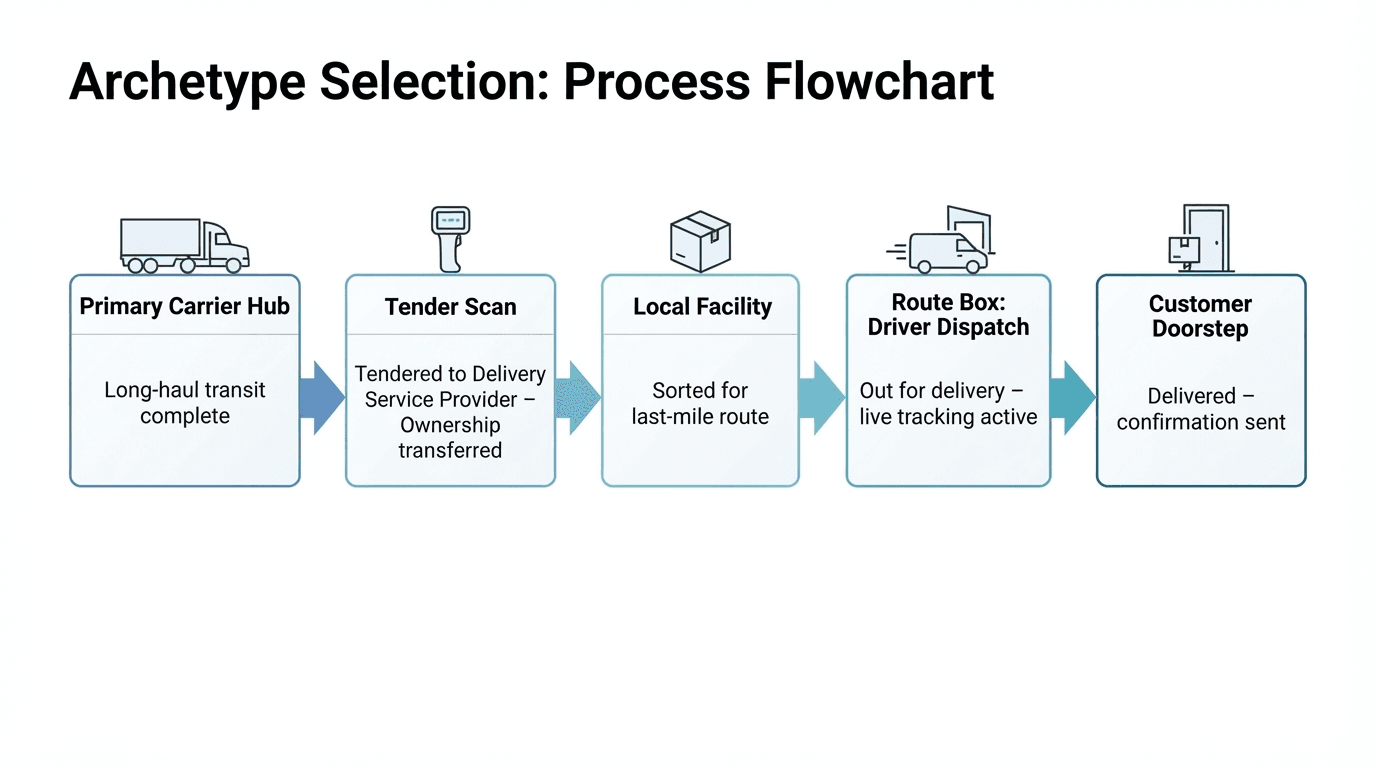
The journey after tender follows a predictable sequence that shippers can manage actively.
Once the primary carrier releases the package, the delivery service provider scans it into its network.
Sorting, local route assignment, and final out-for-delivery steps follow within hours or days depending on distance.
Each scan creates an opportunity for proactive customer messaging.
Clear ownership at every stage prevents packages from sitting untracked in intermediate facilities.
The core sequence looks like this:
Package arrives at regional hub and is tendered
Delivery service provider scans and accepts the shipment
Local sorting and route optimization occur
Out-for-delivery status is triggered
Successful delivery or exception is recorded
Carrier Status Codes Explained
Different carriers use slightly different wording for the same handoff event.
Knowing the exact language helps teams interpret tracking feeds without confusion.
Most major networks still rely on “tendered to delivery service provider” or close variants when transferring to a final-mile partner.
Consistent interpretation across systems is essential for accurate customer notifications.
Shippers benefit from platforms that normalize these status messages into plain language.
Carrier
Typical Status Wording
Common Final-Mile Partner
Typical Time to Delivery After Tender
UPS
Tendered to delivery service provider
USPS or local courier
1–3 days
FedEx
Tendered to delivery service provider / On vehicle for delivery
Local partner or FedEx Home
1–2 days
DHL
Tendered to delivery service provider
USPS, local courier
1–4 days
USPS
Arrived at unit / Out for delivery (rarely uses tender language)
Internal or contractor
Same day or next day
Common Challenges and Practical Solutions
Shippers face recurring friction points right after the tender status appears.
Cost spikes, limited visibility, and coordination gaps between carriers are the most common.
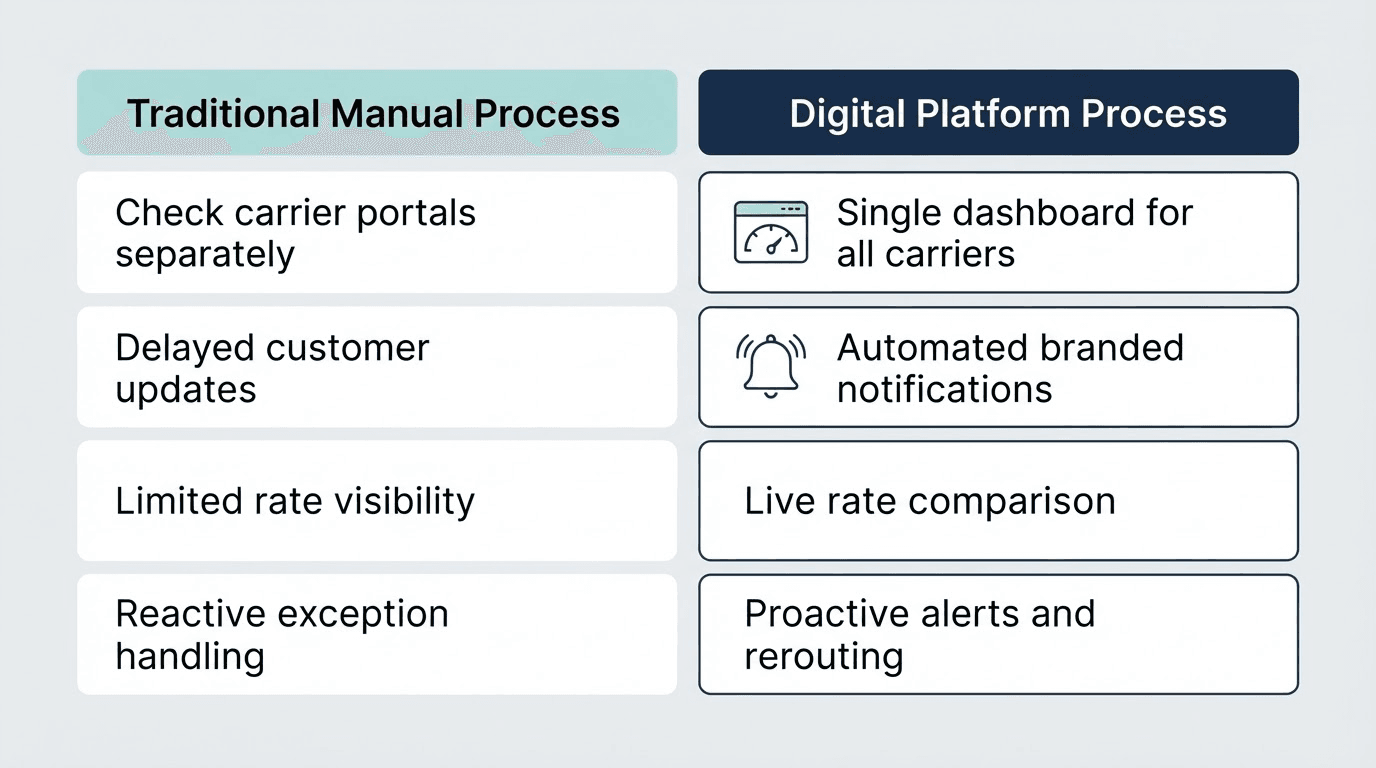
Digital tools that aggregate multi-carrier tracking and automate alerts solve many of these issues.
Integrating warehouse and order systems further reduces manual follow-up work.
Addressing these challenges early protects both margins and customer loyalty.
Key challenges and 2026 solutions include:
High last-mile costs → Compare rates across multiple providers in real time
Visibility gaps after handoff → Use unified tracking dashboards
Failed delivery attempts → Offer flexible delivery windows and locker options
International complexity → Leverage platforms with built-in customs support
Peak-season capacity → Secure flexible capacity contracts in advance
How Digital Platforms Improve Visibility
Modern digital logistics platforms turn the tender status into an actionable signal rather than a black box.Real-time multi-carrier tracking, automated customer notifications, and exception alerts keep both shippers and recipients informed.
Integration with eCommerce and warehouse systems eliminates double entry and reduces errors.
Businesses gain competitive rates, branded tracking pages, and data for continuous improvement.
Platforms that normalize status language across carriers remove confusion for support teams.
Frequently Asked Questions
What does “tendered to delivery service provider” actually mean?
It means the primary carrier has handed the package to a last-mile partner responsible for final delivery to the recipient’s address. This status confirms ownership transfer and usually occurs at a regional hub.
How long does final delivery take after the tender status?
Most domestic shipments reach the doorstep within one to three days after tender, depending on distance, local traffic, and carrier capacity. Express options can reduce this window further.
Why do packages sometimes stall after being tendered?
Delays often stem from local sorting backlogs, weather, capacity shortages, or incorrect address data. Early monitoring of the status helps shippers intervene before customer complaints arise.
Is the tender status the same across all carriers?
Wording varies slightly, but the meaning is consistent: the package has left the primary network and entered the final-mile provider’s system. Platforms that normalize these messages reduce confusion.
Can I choose which delivery service provider receives my package?
Yes. Many digital logistics platforms allow shippers to select preferred last-mile partners or set rules based on destination, service level, and cost.
Does the tender status affect tracking accuracy?
Tracking continues, but the data source switches to the final-mile provider. Unified platforms maintain seamless visibility across both networks.
How can I reduce failed deliveries after the tender stage?
Offer flexible delivery options such as scheduled windows, locker drop-offs, or neighbor authorization. Clear address data and proactive customer notifications also improve first-attempt success rates.
Should small businesses worry about this status?
Absolutely. Even low-volume shippers benefit from understanding the handoff because customer expectations for speed and transparency apply equally to all brands in 2026.
Final Thoughts for Shippers in 2026
Mastering the tendered-to-delivery-service-provider stage is no longer optional for competitive shipping performance.
This single status update sits at the intersection of cost control, customer experience, and operational reliability.
Shippers who combine clear process understanding with modern digital tools gain measurable advantages in speed, visibility, and satisfaction scores.
As eCommerce continues to demand faster and more transparent deliveries, treating the handoff as a strategic moment rather than a passive update will separate leaders from the rest.
For expert guidance, Book a Demo with FreightAmigo.
What does the status "Tendered to Delivery Service Provider" indicate?
It marks the handoff to last-mile delivery. The package has been transferred from the primary courier to a local service for final transport to the recipient.
What role do delivery service providers play?
They handle last-mile delivery. Local couriers or postal services bridge major hubs to the customer's doorstep for efficient final transport.
Why is the final delivery stage important?
It completes the customer experience. Any issues at this touchpoint can affect satisfaction and brand reputation.
What is last-mile delivery?
It is the final leg from distribution center to doorstep. This stage is often the most challenging and costly due to traffic and location factors.
What are the key stages of the delivery process?
They include pickup, transfer, and final delivery. The package moves from seller collection through regional handoff to local carrier completion.
How do carriers interpret the tendered status?
Each uses it to signal last-mile transfer. UPS, DHL, and others hand off to partners like USPS for final delivery.
What shipping challenges do brands face?
They include rising costs, expansion issues, and high customer expectations. Digital platforms help by providing competitive rates, integrations, and real-time tracking.
How can FreightAmigo assist with deliveries?
It offers real-time tracking and carrier networks. The platform supports transparency, cost optimization, and seamless international shipping.



















 Global Popular RoutesTop sea & air shipping lanes
 Special OfferLimited-time shipping promotions


 Express
 Document
 Parcel - Air/Sea
 Container
 Relocation


 Carrier Status Codes Explained