Instant Quote
express Express
document Document
parcel Parcel - Air/Sea
container Container
relocation Relocation
Send from
arrow-drop-down
Deliver to
arrow-drop-down
Load
arrow-drop-down
Search
Table of Contents
Want To Compare The Best Express, Air Freight, Sea Freight, Rail Freight & Trucking Rates So As To Have Better Control On Cost?
If You Wish To Learn More About Ocean Freight Rates, Please Go To The FreightAmigo Page For Inquiries
The procedures for the regulation of restricted items and tariff arrangements are complicated. If you want to safely deliver your favorite items to your new home, it is best to have logistics experts to support you throughout the process! If you are planning to arrange overseas moving, welcome to FreightAmigo’s special page for overseas moving freight quotations.
FreightAmigo offers oversea immigration service to make your move-in easier!
There are different options for cargo transportation. If you want to choose the most convenient and suitable solution, it is best to have the full support of logistics experts! If you are planning to ship goods overseas, please go to the FreightAmigo page for inquiries.
If you are looking for logistics experts, please visit FreightAmigo Page
There Are Different Options For Transporting Goods, And To Choose The Most Convenient And Suitable Solution, It Is Best To Have Full Support From Logistics Experts! If You Are Planning To Ship Goods Overseas, Please Visit The FreightAmigo Page For Inquiries!
FreightAmigo, a supply chain e-marketplace, would ship your documents, small parcels or pallet anywhere in the world with flexible solutions. Get an instant quote on FreightAmigo and make trade easier!
If you’re looking For Cosmetics Shipping, Please Go To The FreightAmigo Page For Inquiries

Fulfillment vs Fulfilment: Unraveling the Spelling Mystery in Global Logistics

Have you ever hesitated when writing an email, wondering whether to use "fulfillment" or "fulfilment" to discuss your eCommerce business? In the fast-paced environment of global logistics, this seemingly minor spelling choice not only reflects regional differences but can also impact communication efficiency and even shape your brand's professional image overseas. As eCommerce continues its rapid growth—with global sales projected to exceed $7 trillion by 2026—mastering these details has become key for logistics managers and e-tailers to build a competitive edge in diverse International Trade.

At FreightAmigo, we assist Hong Kong clients daily in handling orders shipped to Europe, the US, and other regions, frequently encountering this spelling confusion. It might seem like a small matter, but it involves the order processing efficiency of eCommerce fulfillment services and the tight integration of FreighTech with direct-to-consumer experiences. This Guide will fully unravel the mystery of fulfillment vs fulfilment, clarify the differences between eCommerce fulfillment and traditional logistics, and provide practical strategies to help you optimize your supply chain.

Key Takeaways of This Guide

  • Gain deep insights into regional spelling preferences and their commercial impact on International Trade.
  • Analyze the core differences between eCommerce fulfillment services and traditional logistics to support sustainable business expansion.
  • Share proven strategies for choosing top eCommerce fulfillment companies to enhance customer satisfaction.

Regional Spelling and Market Trends Comparison Table

RegionPreferred SpellingeCommerce Market Size (2026 Forecast, $ Trillion)Average Fulfillment Time (Days)
United StatesFulfillment1.62–5
UK / CommonwealthFulfilment0.43–7
European UnionMixed (Mainly Fulfilment)1.24–8
Asia-Pacific (Excl. China)Fulfillment (US Influenced)2.15–10
Global Average-7.0+3–7

Note: This table highlights not only spelling trends but also the importance of aligning eCommerce fulfillment services with regional expectations.

Historical Roots of Fulfillment Spelling

The difference between "fulfillment" and "fulfilment" traces back to the 19th-century standardization of English. American English, influenced by Noah Webster's 1828 dictionary, leaned toward simplified spellings, removing one "l" from "fulfill" to form "fulfillment". British English retained the traditional "fulfil" and "fulfilment", maintaining a connection to Old English etymology.

In global logistics practice, this difference carries deep implications. When drafting contracts, tender documents, or marketing materials for eCommerce fulfillment services, using the wrong spelling might confuse partners. For instance, if a Hong Kong seller expanding into the UK market insists on using "fulfillment", it might be perceived as a lack of attention to detail. We recommend adjusting based on your target audience: use "fulfillment" for the US market and "fulfilment" for Commonwealth countries.

What is eCommerce Fulfillment? 

eCommerce fulfillment (also spelled fulfilment depending on the region) refers to the complete end-to-end process from receiving inventory, storage, picking and packing, to shipping to customers. 

Unlike in-house handling by businesses, professional eCommerce fulfillment providers like FreightAmigo can operate efficiently at scale and seamlessly integrate with platforms like Shopify and Amazon's fulfillment centers.

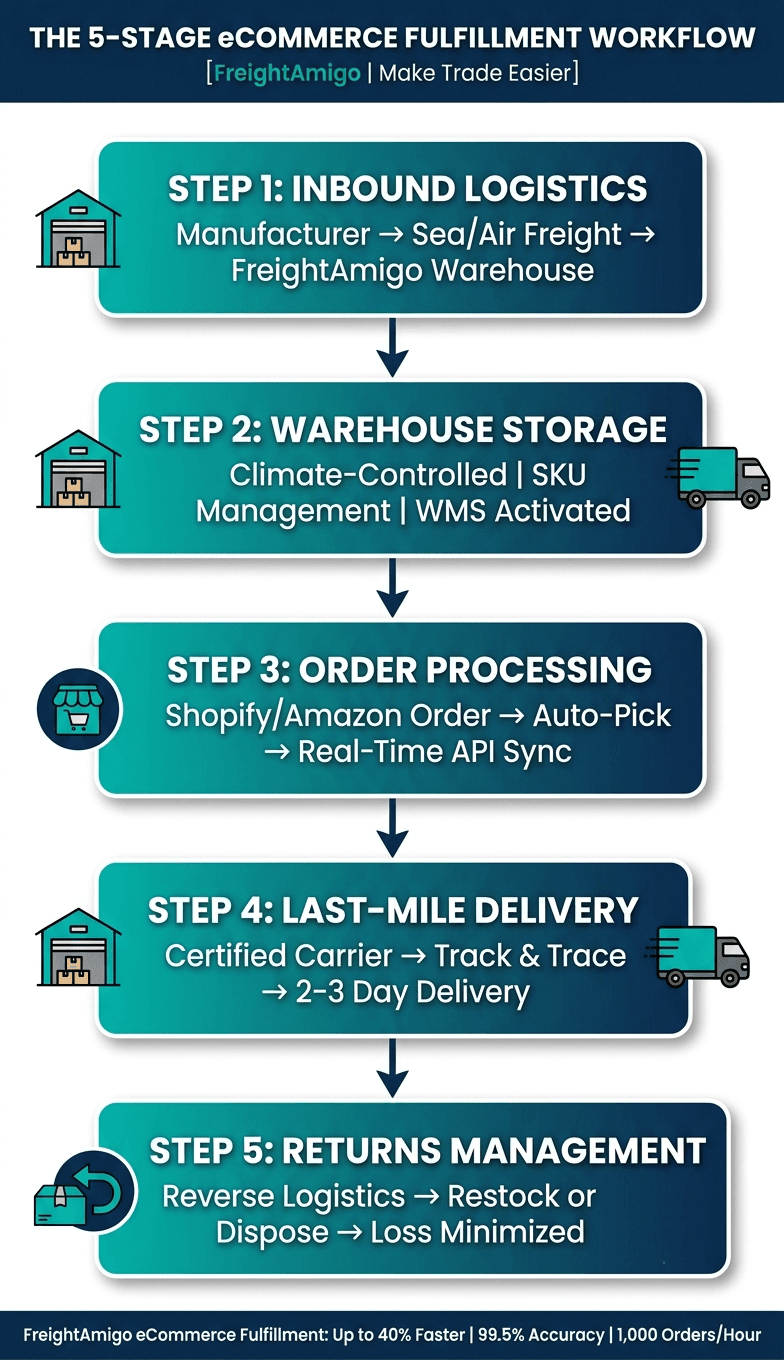
Key Operational Stages Include:

  1. Inbound Logistics: Receiving manufacturers' goods from Asia via sea or air freight.
  2. Warehouse Storage: Utilizing climate-controlled facilities to optimize the management of diverse SKUs (Pallet and Container).
  3. Order Processing: Achieving real-time picking through Warehouse Management Systems (WMS) and API.
  4. Last-Mile Delivery: Partnering with reliable carriers to ensure delivery within 2–3 days.
  5. Returns Management: Efficient Reverse logistics to minimize losses.

By 2026, artificial intelligence-driven automation technology will enable fulfillment centers to process up to 1,000 orders per hour. Our eCommerce fulfillment solutions have helped clients reduce fulfillment times by up to 40% while providing a high-capacity dedicated operating platform.

Fulfillment vs Logistics: Clarifying the Difference

Many people easily confuse fulfillment with logistics. Logistics covers broader supply chain management, including planning, implementing, and controlling the flow of goods from origin to destination. Fulfillment, on the other hand, focuses on order-driven processes after manufacturing, especially the customer-end experience.

AspectFulfillmentLogistics
ScopeOrder picking, packing, shippingTransportation, warehousing, inventory management
FocusCustomer-oriented, speedOverall supply chain efficiency
Key MetricsOrder accuracy (99%+), delivery timeFreight costs, transit time
Example ProvidereCommerce fulfillment centerFreight forwarder

The two are closely linked. We act as the perfect bridge, automating the shipping process from the fulfillment center to your store, combining FreighTech visibility with execution efficiency. Clients using integrated solutions speed up their order cycles by an average of 25%.

Why Choose Professional eCommerce Fulfillment Services?

Handling eCommerce fulfillment in-house easily leads to bottlenecks like stockouts, delays, and rising costs during business expansion. Professional services bring:

  • Scalability: No need to hire massive seasonal staff during peak periods (like Black Friday).
  • Cost Savings: Economies of scale reduce per-order costs by 30–50%.
  • Global Coverage: A multi-warehouse network supports localized fast delivery.
  • Tech Advantage: API for real-time Track & Trace and system integration.
  • Compliance Assurance: Professional handling of tariffs, taxes, and digital customs matters.

Impact of Regional Spelling on Global eCommerce Operations

In the US market, "fulfillment" accounts for about 90% of industry terminology, and platforms like Amazon's fulfillment centers also primarily use this spelling. Conversely, the UK and Australia prefer "fulfilment", impacting contract and software interface wording. Asian sellers should adopt a hybrid strategy: use "fulfillment" when expanding into the US market, and localize spelling when working with local partners.

How to Choose the Right eCommerce Order Fulfillment Company

When selecting a provider, it is recommended to reference the following criteria:

  • Integration Capabilities: Seamlessly connect with platforms like Shopify, WooCommerce, etc.
  • Network Coverage: Warehouse locations situated close to major target markets.
  • Tech Architecture: Advanced WMS, TMS, and API support.
  • Customized Services: Provide value-added services (VAS) like kitting and labeling (including optimization for Harmonized System Code and Shipment Document).
  • Transparent Pricing: No hidden fees.
  • Sustainability: Offer eco-friendly options like carbon-neutral GreenTech solutions.

FreightAmigo excels in this regard, enabling one-click order synchronization and global shipping through eCommerce fulfillment and Shopify applications, truly achieving the goal to Make Trade Easier.

Integrating Fulfillment into Broader Supply Chain Tools

Modern eCommerce fulfillment relies heavily on system integration. Paired with our Track & Trace, customs calculators, and other tools, you can accurately predict ETA and costs. For eCommerce imports into Mainland China, our dedicated services ensure digital customs compliance, smooth digital declarations, and rapid fulfillment.

Case Study: 

A Shopify merchant expanded into the EU market. After using our application, their process from PO to POD was fully automated, manual errors dropped by 60%, and fulfillment costs were reduced by 22%.

Future Trends for eCommerce Fulfillment Providers

Looking ahead to 2026, major development directions include:

  • artificial intelligence optimizing inventory management, reducing stockout rates by up to 50%.
  • Micro-fulfillment centers supporting same-day delivery in urban areas.
  • Sustainable practices combined with GreenTech.
  • Robotics and blockchain technology providing immutable order tracking and high-efficiency routing.

FreightAmigo helps clients lead the market through a full-service, one-stop approach.

Overcoming Common eCommerce Fulfillment Challenges

Peak season overloads, rising returns, and international compliance issues are widespread. Solutions include:

  • A multi-carrier network to balance Trucking costs and speed.
  • Automated Automated Shipment Documentation and value-added services (like customized digital manifests).
  • cloud-based, online real-time visibility dashboards for all stakeholders.

Frequently Asked Questions

  1. What is the difference between fulfillment and fulfilment?

    It is primarily a regional spelling difference: American English uses "fulfillment", while British English uses "fulfilment". Both refer to the exact same eCommerce process.

  2. How does eCommerce fulfillment differ from logistics?

    Fulfillment focuses on order processing and Last-Mile Delivery, whereas logistics encompasses the entire supply chain from procurement to distribution.

  3. Which spelling should global eCommerce businesses use?

    Adjust based on your target audience: use "fulfillment" for the US market and "fulfilment" for the UK/EU. FreightAmigo tools seamlessly support both.

  4. What are the benefits of eCommerce fulfillment services?

    They provide scalability, cost reduction, faster shipping, and professional compliance, allowing businesses to focus on core growth.

  5. How does FreightAmigo support eCommerce order fulfillment?

    We provide end-to-end management through integrated digital logistics platforms, including Shopify apps and eCommerce fulfillment services.

Conclusion

From understanding fulfillment vs fulfilment to choosing the right eCommerce fulfillment provider, this Guide helps you build an advantage in global logistics. Whether expanding a Shopify store or optimizing logistics for Amazon's fulfillment centers (Less than Container Load or Full Container Load), FreightAmigo delivers value by combining innovative technologies (integrating FinTech and InsurTech) with reliable services to Make Trade Easier.

Ready to streamline your process? Get a quote via our online instant quotation tool, or explore eCommerce fulfillment today.

Mastering eCommerce Logistics: Fulfillment vs Fulfilment? Guide to Optimizing Your Supply Chain

Have you ever hesitated when writing an email, wondering whether to use "fulfillment" or "fulfilment" to discuss your eCommerce business? In the fast-paced environment of global logistics, this seemingly minor spelling choice not only reflects regional differences but can also impact communication efficiency and even shape your brand's professional image overseas. As eCommerce continues its rapid growth—with global sales projected to exceed $7 trillion by 2026—mastering these details has become key for logistics managers and e-tailers to build a competitive edge in diverse International Trade.

At FreightAmigo, we assist Hong Kong clients daily in handling orders shipped to Europe, the US, and other regions, frequently encountering this spelling confusion. It might seem like a small matter, but it involves the order processing efficiency of eCommerce fulfillment services and the tight integration of FreighTech with direct-to-consumer experiences. This Guide will fully unravel the mystery of fulfillment vs fulfilment, clarify the differences between eCommerce fulfillment and traditional logistics, and provide practical strategies to help you optimize your supply chain.

Key Takeaways of This Guide

  • Gain deep insights into regional spelling preferences and their commercial impact on International Trade.

  • Analyze the core differences between eCommerce fulfillment services and traditional logistics to support sustainable business expansion.

  • Share proven strategies for choosing top eCommerce fulfillment companies to enhance customer satisfaction.

Regional Spelling and Market Trends Comparison Table

RegionPreferred SpellingeCommerce Market Size (2026 Forecast, $ Trillion)Average Fulfillment Time (Days)
United StatesFulfillment1.62–5
UK / CommonwealthFulfilment0.43–7
European UnionMixed (Mainly Fulfilment)1.24–8
Asia-Pacific (Excl. China)Fulfillment (US Influenced)2.15–10
Global Average-7.0+3–7

Note: This table highlights not only spelling trends but also the importance of aligning eCommerce fulfillment services with regional expectations.

Historical Roots of Fulfillment Spelling

The difference between "fulfillment" and "fulfilment" traces back to the 19th-century standardization of English. American English, influenced by Noah Webster's 1828 dictionary, leaned toward simplified spellings, removing one "l" from "fulfill" to form "fulfillment". British English retained the traditional "fulfil" and "fulfilment", maintaining a connection to Old English etymology.

In global logistics practice, this difference carries deep implications. When drafting contracts, tender documents, or marketing materials for eCommerce fulfillment services, using the wrong spelling might confuse partners. For instance, if a Hong Kong seller expanding into the UK market insists on using "fulfillment", it might be perceived as a lack of attention to detail. We recommend adjusting based on your target audience: use "fulfillment" for the US market and "fulfilment" for Commonwealth countries.

Furthermore, Search Engine Optimization (SEO) is also affected. Although Google views both as the same concept, regional algorithms prefer localized terms. The search volume for "ecommerce fulfillment service" in the US accounts for over 70%, while the UK and Australia are dominated by "ecommerce fulfilment services". Many clients have seen a 15–20% increase in organic traffic after adopting a dual-spelling strategy.

What is eCommerce Fulfillment? In-Depth Analysis

eCommerce fulfillment (also spelled fulfilment depending on the region) refers to the complete end-to-end process from receiving inventory, storage, picking and packing, to shipping to customers. Unlike in-house handling by businesses, professional eCommerce fulfillment providers like FreightAmigo can operate efficiently at scale and seamlessly integrate with platforms like Shopify and Amazon's fulfillment centers.

Key Operational Stages Include:

  1. Inbound Logistics: Receiving manufacturers' goods from Asia via sea or air freight.

  2. Warehouse Storage: Utilizing climate-controlled facilities to optimize the management of diverse SKUs (Pallet and Container).

  3. Order Processing: Achieving real-time picking through Warehouse Management Systems (WMS) and API.

  4. Last-Mile Delivery: Partnering with reliable carriers to ensure delivery within 2–3 days.

  5. Returns Management: Efficient Reverse logistics to minimize losses.

By 2026, artificial intelligence-driven automation technology will enable fulfillment centers to process up to 1,000 orders per hour. Our eCommerce fulfillment solutions have helped clients reduce fulfillment times by up to 40% while providing a high-capacity dedicated operating platform.

Fulfillment vs Logistics: Clarifying the Difference

Many people easily confuse fulfillment with logistics. Logistics covers broader supply chain management, including planning, implementing, and controlling the flow of goods from origin to destination. Fulfillment, on the other hand, focuses on order-driven processes after manufacturing, especially the customer-end experience.

AspectFulfillmentLogistics
ScopeOrder picking, packing, shippingTransportation, warehousing, inventory management
FocusCustomer-oriented, speedOverall supply chain efficiency
Key MetricsOrder accuracy (99%+), delivery timeFreight costs, transit time
Example ProvidereCommerce fulfillment centerFreight forwarder

The two are closely linked. We act as the perfect bridge, automating the shipping process from the fulfillment center to your store, combining FreighTech visibility with execution efficiency. Clients using integrated solutions speed up their order cycles by an average of 25%.

Why Choose Professional eCommerce Fulfillment Services?

Handling eCommerce fulfillment in-house easily leads to bottlenecks like stockouts, delays, and rising costs during business expansion. Professional services bring:

  • Scalability: No need to hire massive seasonal staff during peak periods (like Black Friday).

  • Cost Savings: Economies of scale reduce per-order costs by 30–50%.

  • Global Coverage: A multi-warehouse network supports localized fast delivery.

  • Tech Advantage: API for real-time Track & Trace and system integration.

  • Compliance Assurance: Professional handling of tariffs, taxes, and digital customs matters.

Case Study: Take a mid-sized Hong Kong apparel brand we partner with: before implementing FreightAmigo's services, in-house fulfillment resulted in a 15% return rate. After implementation, order accuracy rose to 99.5%, the Net Promoter Score (NPS) increased by 35 points, and their expansion into the European market became much smoother.

Impact of Regional Spelling on Global eCommerce Operations

In the US market, "fulfillment" accounts for about 90% of industry terminology, and platforms like Amazon's fulfillment centers also primarily use this spelling. Conversely, the UK and Australia prefer "fulfilment", impacting contract and software interface wording. Asian sellers should adopt a hybrid strategy: use "fulfillment" when expanding into the US market, and localize spelling when working with local partners.

Search Volume Data Shows (2026 Estimates):

  • US: "eCommerce fulfillment" receives around 1.2 million monthly searches.

  • UK/Australia: "eCommerce fulfilment services" combined receive around 450,000 searches.

We advise clients to localize content: use "fulfillment" for North American sales funnels and "fulfilment" for the UK market to effectively boost conversion rates.

How to Choose the Right eCommerce Order Fulfillment Company

When selecting a provider, it is recommended to reference the following criteria:

  • Integration Capabilities: Seamlessly connect with platforms like Shopify, WooCommerce, etc.

  • Network Coverage: Warehouse locations situated close to major target markets.

  • Tech Architecture: Advanced WMS, TMS, and API support.

  • Customized Services: Provide value-added services (VAS) like kitting and labeling (including optimization for Harmonized System Code and Shipment Document).

  • Transparent Pricing: No hidden fees.

  • Sustainability: Offer eco-friendly options like carbon-neutral GreenTech solutions.

FreightAmigo excels in this regard, enabling one-click order synchronization and global shipping through eCommerce fulfillment and Shopify applications, truly achieving the goal to Make Trade Easier.

Integrating Fulfillment into Broader Supply Chain Tools

Modern eCommerce fulfillment relies heavily on system integration. Paired with our Track & Trace, customs calculators, and other tools, you can accurately predict ETA and costs. For eCommerce imports into Mainland China, our dedicated services ensure digital customs compliance, smooth digital declarations, and rapid fulfillment.

Case Study: A Shopify merchant expanded into the EU market. After using our application, their process from PO to POD was fully automated, manual errors dropped by 60%, and fulfillment costs were reduced by 22%.

Future Trends for eCommerce Fulfillment Providers

Looking ahead to 2026, major development directions include:

  • artificial intelligence optimizing inventory management, reducing stockout rates by up to 50%.

  • Micro-fulfillment centers supporting same-day delivery in urban areas.

  • Sustainable practices combined with GreenTech.

  • Robotics and blockchain technology providing immutable order tracking and high-efficiency routing.

FreightAmigo helps clients lead the market through a full-service, one-stop approach.

Overcoming Common eCommerce Fulfillment Challenges

Peak season overloads, rising returns, and international compliance issues are widespread. Solutions include:

  • A multi-carrier network to balance Trucking costs and speed.

  • Automated Automated Shipment Documentation and value-added services (like customized digital manifests).

  • cloud-based, online real-time visibility dashboards for all stakeholders.

Frequently Asked Questions

What is the difference between fulfillment and fulfilment?

It is primarily a regional spelling difference: American English uses "fulfillment", while British English uses "fulfilment". Both refer to the exact same eCommerce process.

How does eCommerce fulfillment differ from logistics?

Fulfillment focuses on order processing and Last-Mile Delivery, whereas logistics encompasses the entire supply chain from procurement to distribution.

Which spelling should global eCommerce businesses use?

Adjust based on your target audience: use "fulfillment" for the US market and "fulfilment" for the UK/EU. FreightAmigo tools seamlessly support both.

What are the benefits of eCommerce fulfillment services?

They provide scalability, cost reduction, faster shipping, and professional compliance, allowing businesses to focus on core growth.

How does FreightAmigo support eCommerce order fulfillment?

We provide end-to-end management through integrated digital logistics platforms, including Shopify apps and eCommerce fulfillment services.

Conclusion

From understanding fulfillment vs fulfilment to choosing the right eCommerce fulfillment provider, this Guide helps you build an advantage in global logistics. Whether expanding a Shopify store or optimizing logistics for Amazon's fulfillment centers (Less than Container Load or Full Container Load), FreightAmigo delivers value by combining innovative technologies (integrating FinTech and InsurTech) with reliable services to Make Trade Easier.

Ready to streamline your process? Get a quote via our online instant quotation tool, or explore eCommerce fulfillment today.

Mastering eCommerce Logistics: Fulfillment vs Fulfilment? Guide to Optimizing Your Supply Chain

Have you ever hesitated when writing an email, wondering whether to use "fulfillment" or "fulfilment" to discuss your eCommerce business? In the fast-paced environment of global logistics, this seemingly minor spelling choice not only reflects regional differences but can also impact communication efficiency and even shape your brand's professional image overseas. As eCommerce continues its rapid growth—with global sales projected to exceed $7 trillion by 2026—mastering these details has become key for logistics managers and e-tailers to build a competitive edge in diverse International Trade.

At FreightAmigo, we assist Hong Kong clients daily in handling orders shipped to Europe, the US, and other regions, frequently encountering this spelling confusion. It might seem like a small matter, but it involves the order processing efficiency of eCommerce fulfillment services and the tight integration of FreighTech with direct-to-consumer experiences. This Guide will fully unravel the mystery of fulfillment vs fulfilment, clarify the differences between eCommerce fulfillment and traditional logistics, and provide practical strategies to help you optimize your supply chain.

Key Takeaways of This Guide

  • Gain deep insights into regional spelling preferences and their commercial impact on International Trade.

  • Analyze the core differences between eCommerce fulfillment services and traditional logistics to support sustainable business expansion.

  • Share proven strategies for choosing top eCommerce fulfillment companies to enhance customer satisfaction.

Regional Spelling and Market Trends Comparison Table

RegionPreferred SpellingeCommerce Market Size (2026 Forecast, $ Trillion)Average Fulfillment Time (Days)
United StatesFulfillment1.62–5
UK / CommonwealthFulfilment0.43–7
European UnionMixed (Mainly Fulfilment)1.24–8
Asia-Pacific (Excl. China)Fulfillment (US Influenced)2.15–10
Global Average-7.0+3–7

Note: This table highlights not only spelling trends but also the importance of aligning eCommerce fulfillment services with regional expectations.

Historical Roots of Fulfillment Spelling

The difference between "fulfillment" and "fulfilment" traces back to the 19th-century standardization of English. American English, influenced by Noah Webster's 1828 dictionary, leaned toward simplified spellings, removing one "l" from "fulfill" to form "fulfillment". British English retained the traditional "fulfil" and "fulfilment", maintaining a connection to Old English etymology.

In global logistics practice, this difference carries deep implications. When drafting contracts, tender documents, or marketing materials for eCommerce fulfillment services, using the wrong spelling might confuse partners. For instance, if a Hong Kong seller expanding into the UK market insists on using "fulfillment", it might be perceived as a lack of attention to detail. We recommend adjusting based on your target audience: use "fulfillment" for the US market and "fulfilment" for Commonwealth countries.

Furthermore, Search Engine Optimization (SEO) is also affected. Although Google views both as the same concept, regional algorithms prefer localized terms. The search volume for "ecommerce fulfillment service" in the US accounts for over 70%, while the UK and Australia are dominated by "ecommerce fulfilment services". Many clients have seen a 15–20% increase in organic traffic after adopting a dual-spelling strategy.

What is eCommerce Fulfillment? In-Depth Analysis

eCommerce fulfillment (also spelled fulfilment depending on the region) refers to the complete end-to-end process from receiving inventory, storage, picking and packing, to shipping to customers. Unlike in-house handling by businesses, professional eCommerce fulfillment providers like FreightAmigo can operate efficiently at scale and seamlessly integrate with platforms like Shopify and Amazon's fulfillment centers.

Key Operational Stages Include:

  1. Inbound Logistics: Receiving manufacturers' goods from Asia via sea or air freight.

  2. Warehouse Storage: Utilizing climate-controlled facilities to optimize the management of diverse SKUs (Pallet and Container).

  3. Order Processing: Achieving real-time picking through Warehouse Management Systems (WMS) and API.

  4. Last-Mile Delivery: Partnering with reliable carriers to ensure delivery within 2–3 days.

  5. Returns Management: Efficient Reverse logistics to minimize losses.

By 2026, artificial intelligence-driven automation technology will enable fulfillment centers to process up to 1,000 orders per hour. Our eCommerce fulfillment solutions have helped clients reduce fulfillment times by up to 40% while providing a high-capacity dedicated operating platform.

Fulfillment vs Logistics: Clarifying the Difference

Many people easily confuse fulfillment with logistics. Logistics covers broader supply chain management, including planning, implementing, and controlling the flow of goods from origin to destination. Fulfillment, on the other hand, focuses on order-driven processes after manufacturing, especially the customer-end experience.

AspectFulfillmentLogistics
ScopeOrder picking, packing, shippingTransportation, warehousing, inventory management
FocusCustomer-oriented, speedOverall supply chain efficiency
Key MetricsOrder accuracy (99%+), delivery timeFreight costs, transit time
Example ProvidereCommerce fulfillment centerFreight forwarder

The two are closely linked. We act as the perfect bridge, automating the shipping process from the fulfillment center to your store, combining FreighTech visibility with execution efficiency. Clients using integrated solutions speed up their order cycles by an average of 25%.

Why Choose Professional eCommerce Fulfillment Services?

Handling eCommerce fulfillment in-house easily leads to bottlenecks like stockouts, delays, and rising costs during business expansion. Professional services bring:

  • Scalability: No need to hire massive seasonal staff during peak periods (like Black Friday).

  • Cost Savings: Economies of scale reduce per-order costs by 30–50%.

  • Global Coverage: A multi-warehouse network supports localized fast delivery.

  • Tech Advantage: API for real-time Track & Trace and system integration.

  • Compliance Assurance: Professional handling of tariffs, taxes, and digital customs matters.

Case Study: Take a mid-sized Hong Kong apparel brand we partner with: before implementing FreightAmigo's services, in-house fulfillment resulted in a 15% return rate. After implementation, order accuracy rose to 99.5%, the Net Promoter Score (NPS) increased by 35 points, and their expansion into the European market became much smoother.

Impact of Regional Spelling on Global eCommerce Operations

In the US market, "fulfillment" accounts for about 90% of industry terminology, and platforms like Amazon's fulfillment centers also primarily use this spelling. Conversely, the UK and Australia prefer "fulfilment", impacting contract and software interface wording. Asian sellers should adopt a hybrid strategy: use "fulfillment" when expanding into the US market, and localize spelling when working with local partners.

Search Volume Data Shows (2026 Estimates):

  • US: "eCommerce fulfillment" receives around 1.2 million monthly searches.

  • UK/Australia: "eCommerce fulfilment services" combined receive around 450,000 searches.

We advise clients to localize content: use "fulfillment" for North American sales funnels and "fulfilment" for the UK market to effectively boost conversion rates.

How to Choose the Right eCommerce Order Fulfillment Company

When selecting a provider, it is recommended to reference the following criteria:

  • Integration Capabilities: Seamlessly connect with platforms like Shopify, WooCommerce, etc.

  • Network Coverage: Warehouse locations situated close to major target markets.

  • Tech Architecture: Advanced WMS, TMS, and API support.

  • Customized Services: Provide value-added services (VAS) like kitting and labeling (including optimization for Harmonized System Code and Shipment Document).

  • Transparent Pricing: No hidden fees.

  • Sustainability: Offer eco-friendly options like carbon-neutral GreenTech solutions.

FreightAmigo excels in this regard, enabling one-click order synchronization and global shipping through eCommerce fulfillment and Shopify applications, truly achieving the goal to Make Trade Easier.

Integrating Fulfillment into Broader Supply Chain Tools

Modern eCommerce fulfillment relies heavily on system integration. Paired with our Track & Trace, customs calculators, and other tools, you can accurately predict ETA and costs. For eCommerce imports into Mainland China, our dedicated services ensure digital customs compliance, smooth digital declarations, and rapid fulfillment.

Case Study: A Shopify merchant expanded into the EU market. After using our application, their process from PO to POD was fully automated, manual errors dropped by 60%, and fulfillment costs were reduced by 22%.

Future Trends for eCommerce Fulfillment Providers

Looking ahead to 2026, major development directions include:

  • artificial intelligence optimizing inventory management, reducing stockout rates by up to 50%.

  • Micro-fulfillment centers supporting same-day delivery in urban areas.

  • Sustainable practices combined with GreenTech.

  • Robotics and blockchain technology providing immutable order tracking and high-efficiency routing.

FreightAmigo helps clients lead the market through a full-service, one-stop approach.

Overcoming Common eCommerce Fulfillment Challenges

Peak season overloads, rising returns, and international compliance issues are widespread. Solutions include:

  • A multi-carrier network to balance Trucking costs and speed.

  • Automated Automated Shipment Documentation and value-added services (like customized digital manifests).

  • cloud-based, online real-time visibility dashboards for all stakeholders.

Frequently Asked Questions

What is the difference between fulfillment and fulfilment?

It is primarily a regional spelling difference: American English uses "fulfillment", while British English uses "fulfilment". Both refer to the exact same eCommerce process.

How does eCommerce fulfillment differ from logistics?

Fulfillment focuses on order processing and Last-Mile Delivery, whereas logistics encompasses the entire supply chain from procurement to distribution.

Which spelling should global eCommerce businesses use?

Adjust based on your target audience: use "fulfillment" for the US market and "fulfilment" for the UK/EU. FreightAmigo tools seamlessly support both.

What are the benefits of eCommerce fulfillment services?

They provide scalability, cost reduction, faster shipping, and professional compliance, allowing businesses to focus on core growth.

How does FreightAmigo support eCommerce order fulfillment?

We provide end-to-end management through integrated digital logistics platforms, including Shopify apps and eCommerce fulfillment services.

Conclusion

From understanding fulfillment vs fulfilment to choosing the right eCommerce fulfillment provider, this Guide helps you build an advantage in global logistics. Whether expanding a Shopify store or optimizing logistics for Amazon's fulfillment centers (Less than Container Load or Full Container Load), FreightAmigo delivers value by combining innovative technologies (integrating FinTech and InsurTech) with reliable services to Make Trade Easier.

Ready to streamline your process? Get a quote via our online instant quotation tool, or explore eCommerce fulfillment today.

Mastering eCommerce Logistics: Fulfillment vs Fulfilment? Guide to Optimizing Your Supply Chain

Have you ever hesitated when writing an email, wondering whether to use "fulfillment" or "fulfilment" to discuss your eCommerce business? In the fast-paced environment of global logistics, this seemingly minor spelling choice not only reflects regional differences but can also impact communication efficiency and even shape your brand's professional image overseas. As eCommerce continues its rapid growth—with global sales projected to exceed $7 trillion by 2026—mastering these details has become key for logistics managers and e-tailers to build a competitive edge in diverse International Trade.

At FreightAmigo, we assist Hong Kong clients daily in handling orders shipped to Europe, the US, and other regions, frequently encountering this spelling confusion. It might seem like a small matter, but it involves the order processing efficiency of eCommerce fulfillment services and the tight integration of FreighTech with direct-to-consumer experiences. This Guide will fully unravel the mystery of fulfillment vs fulfilment, clarify the differences between eCommerce fulfillment and traditional logistics, and provide practical strategies to help you optimize your supply chain.

Key Takeaways of This Guide

  • Gain deep insights into regional spelling preferences and their commercial impact on International Trade.

  • Analyze the core differences between eCommerce fulfillment services and traditional logistics to support sustainable business expansion.

  • Share proven strategies for choosing top eCommerce fulfillment companies to enhance customer satisfaction.

Regional Spelling and Market Trends Comparison Table

RegionPreferred SpellingeCommerce Market Size (2026 Forecast, $ Trillion)Average Fulfillment Time (Days)
United StatesFulfillment1.62–5
UK / CommonwealthFulfilment0.43–7
European UnionMixed (Mainly Fulfilment)1.24–8
Asia-Pacific (Excl. China)Fulfillment (US Influenced)2.15–10
Global Average-7.0+3–7

Note: This table highlights not only spelling trends but also the importance of aligning eCommerce fulfillment services with regional expectations.

Historical Roots of Fulfillment Spelling

The difference between "fulfillment" and "fulfilment" traces back to the 19th-century standardization of English. American English, influenced by Noah Webster's 1828 dictionary, leaned toward simplified spellings, removing one "l" from "fulfill" to form "fulfillment". British English retained the traditional "fulfil" and "fulfilment", maintaining a connection to Old English etymology.

In global logistics practice, this difference carries deep implications. When drafting contracts, tender documents, or marketing materials for eCommerce fulfillment services, using the wrong spelling might confuse partners. For instance, if a Hong Kong seller expanding into the UK market insists on using "fulfillment", it might be perceived as a lack of attention to detail. We recommend adjusting based on your target audience: use "fulfillment" for the US market and "fulfilment" for Commonwealth countries.

Furthermore, Search Engine Optimization (SEO) is also affected. Although Google views both as the same concept, regional algorithms prefer localized terms. The search volume for "ecommerce fulfillment service" in the US accounts for over 70%, while the UK and Australia are dominated by "ecommerce fulfilment services". Many clients have seen a 15–20% increase in organic traffic after adopting a dual-spelling strategy.

What is eCommerce Fulfillment? In-Depth Analysis

eCommerce fulfillment (also spelled fulfilment depending on the region) refers to the complete end-to-end process from receiving inventory, storage, picking and packing, to shipping to customers. Unlike in-house handling by businesses, professional eCommerce fulfillment providers like FreightAmigo can operate efficiently at scale and seamlessly integrate with platforms like Shopify and Amazon's fulfillment centers.

Key Operational Stages Include:

  1. Inbound Logistics: Receiving manufacturers' goods from Asia via sea or air freight.

  2. Warehouse Storage: Utilizing climate-controlled facilities to optimize the management of diverse SKUs (Pallet and Container).

  3. Order Processing: Achieving real-time picking through Warehouse Management Systems (WMS) and API.

  4. Last-Mile Delivery: Partnering with reliable carriers to ensure delivery within 2–3 days.

  5. Returns Management: Efficient Reverse logistics to minimize losses.

By 2026, artificial intelligence-driven automation technology will enable fulfillment centers to process up to 1,000 orders per hour. Our eCommerce fulfillment solutions have helped clients reduce fulfillment times by up to 40% while providing a high-capacity dedicated operating platform.

Fulfillment vs Logistics: Clarifying the Difference

Many people easily confuse fulfillment with logistics. Logistics covers broader supply chain management, including planning, implementing, and controlling the flow of goods from origin to destination. Fulfillment, on the other hand, focuses on order-driven processes after manufacturing, especially the customer-end experience.

AspectFulfillmentLogistics
ScopeOrder picking, packing, shippingTransportation, warehousing, inventory management
FocusCustomer-oriented, speedOverall supply chain efficiency
Key MetricsOrder accuracy (99%+), delivery timeFreight costs, transit time
Example ProvidereCommerce fulfillment centerFreight forwarder

The two are closely linked. We act as the perfect bridge, automating the shipping process from the fulfillment center to your store, combining FreighTech visibility with execution efficiency. Clients using integrated solutions speed up their order cycles by an average of 25%.

Why Choose Professional eCommerce Fulfillment Services?

Handling eCommerce fulfillment in-house easily leads to bottlenecks like stockouts, delays, and rising costs during business expansion. Professional services bring:

  • Scalability: No need to hire massive seasonal staff during peak periods (like Black Friday).

  • Cost Savings: Economies of scale reduce per-order costs by 30–50%.

  • Global Coverage: A multi-warehouse network supports localized fast delivery.

  • Tech Advantage: API for real-time Track & Trace and system integration.

  • Compliance Assurance: Professional handling of tariffs, taxes, and digital customs matters.

Case Study: Take a mid-sized Hong Kong apparel brand we partner with: before implementing FreightAmigo's services, in-house fulfillment resulted in a 15% return rate. After implementation, order accuracy rose to 99.5%, the Net Promoter Score (NPS) increased by 35 points, and their expansion into the European market became much smoother.

Impact of Regional Spelling on Global eCommerce Operations

In the US market, "fulfillment" accounts for about 90% of industry terminology, and platforms like Amazon's fulfillment centers also primarily use this spelling. Conversely, the UK and Australia prefer "fulfilment", impacting contract and software interface wording. Asian sellers should adopt a hybrid strategy: use "fulfillment" when expanding into the US market, and localize spelling when working with local partners.

Search Volume Data Shows (2026 Estimates):

  • US: "eCommerce fulfillment" receives around 1.2 million monthly searches.

  • UK/Australia: "eCommerce fulfilment services" combined receive around 450,000 searches.

We advise clients to localize content: use "fulfillment" for North American sales funnels and "fulfilment" for the UK market to effectively boost conversion rates.

How to Choose the Right eCommerce Order Fulfillment Company

When selecting a provider, it is recommended to reference the following criteria:

  • Integration Capabilities: Seamlessly connect with platforms like Shopify, WooCommerce, etc.

  • Network Coverage: Warehouse locations situated close to major target markets.

  • Tech Architecture: Advanced WMS, TMS, and API support.

  • Customized Services: Provide value-added services (VAS) like kitting and labeling (including optimization for Harmonized System Code and Shipment Document).

  • Transparent Pricing: No hidden fees.

  • Sustainability: Offer eco-friendly options like carbon-neutral GreenTech solutions.

FreightAmigo excels in this regard, enabling one-click order synchronization and global shipping through eCommerce fulfillment and Shopify applications, truly achieving the goal to Make Trade Easier.

Integrating Fulfillment into Broader Supply Chain Tools

Modern eCommerce fulfillment relies heavily on system integration. Paired with our Track & Trace, customs calculators, and other tools, you can accurately predict ETA and costs. For eCommerce imports into Mainland China, our dedicated services ensure digital customs compliance, smooth digital declarations, and rapid fulfillment.

Case Study: A Shopify merchant expanded into the EU market. After using our application, their process from PO to POD was fully automated, manual errors dropped by 60%, and fulfillment costs were reduced by 22%.

Future Trends for eCommerce Fulfillment Providers

Looking ahead to 2026, major development directions include:

  • artificial intelligence optimizing inventory management, reducing stockout rates by up to 50%.

  • Micro-fulfillment centers supporting same-day delivery in urban areas.

  • Sustainable practices combined with GreenTech.

  • Robotics and blockchain technology providing immutable order tracking and high-efficiency routing.

FreightAmigo helps clients lead the market through a full-service, one-stop approach.

Overcoming Common eCommerce Fulfillment Challenges

Peak season overloads, rising returns, and international compliance issues are widespread. Solutions include:

  • A multi-carrier network to balance Trucking costs and speed.

  • Automated Automated Shipment Documentation and value-added services (like customized digital manifests).

  • cloud-based, online real-time visibility dashboards for all stakeholders.

Frequently Asked Questions

What is the difference between fulfillment and fulfilment?

It is primarily a regional spelling difference: American English uses "fulfillment", while British English uses "fulfilment". Both refer to the exact same eCommerce process.

How does eCommerce fulfillment differ from logistics?

Fulfillment focuses on order processing and Last-Mile Delivery, whereas logistics encompasses the entire supply chain from procurement to distribution.

Which spelling should global eCommerce businesses use?

Adjust based on your target audience: use "fulfillment" for the US market and "fulfilment" for the UK/EU. FreightAmigo tools seamlessly support both.

What are the benefits of eCommerce fulfillment services?

They provide scalability, cost reduction, faster shipping, and professional compliance, allowing businesses to focus on core growth.

How does FreightAmigo support eCommerce order fulfillment?

We provide end-to-end management through integrated digital logistics platforms, including Shopify apps and eCommerce fulfillment services.

Conclusion

From understanding fulfillment vs fulfilment to choosing the right eCommerce fulfillment provider, this Guide helps you build an advantage in global logistics. Whether expanding a Shopify store or optimizing logistics for Amazon's fulfillment centers (Less than Container Load or Full Container Load), FreightAmigo delivers value by combining innovative technologies (integrating FinTech and InsurTech) with reliable services to Make Trade Easier.

Ready to streamline your process? Get a quote via our online instant quotation tool, or explore eCommerce fulfillment today.

Mastering eCommerce Logistics: Fulfillment vs Fulfilment? Guide to Optimizing Your Supply Chain

Have you ever hesitated when writing an email, wondering whether to use "fulfillment" or "fulfilment" to discuss your eCommerce business? In the fast-paced environment of global logistics, this seemingly minor spelling choice not only reflects regional differences but can also impact communication efficiency and even shape your brand's professional image overseas. As eCommerce continues its rapid growth—with global sales projected to exceed $7 trillion by 2026—mastering these details has become key for logistics managers and e-tailers to build a competitive edge in diverse International Trade.

At FreightAmigo, we assist Hong Kong clients daily in handling orders shipped to Europe, the US, and other regions, frequently encountering this spelling confusion. It might seem like a small matter, but it involves the order processing efficiency of eCommerce fulfillment services and the tight integration of FreighTech with direct-to-consumer experiences. This Guide will fully unravel the mystery of fulfillment vs fulfilment, clarify the differences between eCommerce fulfillment and traditional logistics, and provide practical strategies to help you optimize your supply chain.

Key Takeaways of This Guide

  • Gain deep insights into regional spelling preferences and their commercial impact on International Trade.

  • Analyze the core differences between eCommerce fulfillment services and traditional logistics to support sustainable business expansion.

  • Share proven strategies for choosing top eCommerce fulfillment companies to enhance customer satisfaction.

Regional Spelling and Market Trends Comparison Table

RegionPreferred SpellingeCommerce Market Size (2026 Forecast, $ Trillion)Average Fulfillment Time (Days)
United StatesFulfillment1.62–5
UK / CommonwealthFulfilment0.43–7
European UnionMixed (Mainly Fulfilment)1.24–8
Asia-Pacific (Excl. China)Fulfillment (US Influenced)2.15–10
Global Average-7.0+3–7

Note: This table highlights not only spelling trends but also the importance of aligning eCommerce fulfillment services with regional expectations.

Historical Roots of Fulfillment Spelling

The difference between "fulfillment" and "fulfilment" traces back to the 19th-century standardization of English. American English, influenced by Noah Webster's 1828 dictionary, leaned toward simplified spellings, removing one "l" from "fulfill" to form "fulfillment". British English retained the traditional "fulfil" and "fulfilment", maintaining a connection to Old English etymology.

In global logistics practice, this difference carries deep implications. When drafting contracts, tender documents, or marketing materials for eCommerce fulfillment services, using the wrong spelling might confuse partners. For instance, if a Hong Kong seller expanding into the UK market insists on using "fulfillment", it might be perceived as a lack of attention to detail. We recommend adjusting based on your target audience: use "fulfillment" for the US market and "fulfilment" for Commonwealth countries.

Furthermore, Search Engine Optimization (SEO) is also affected. Although Google views both as the same concept, regional algorithms prefer localized terms. The search volume for "ecommerce fulfillment service" in the US accounts for over 70%, while the UK and Australia are dominated by "ecommerce fulfilment services". Many clients have seen a 15–20% increase in organic traffic after adopting a dual-spelling strategy.

What is eCommerce Fulfillment? In-Depth Analysis

eCommerce fulfillment (also spelled fulfilment depending on the region) refers to the complete end-to-end process from receiving inventory, storage, picking and packing, to shipping to customers. Unlike in-house handling by businesses, professional eCommerce fulfillment providers like FreightAmigo can operate efficiently at scale and seamlessly integrate with platforms like Shopify and Amazon's fulfillment centers.

Key Operational Stages Include:

  1. Inbound Logistics: Receiving manufacturers' goods from Asia via sea or air freight.

  2. Warehouse Storage: Utilizing climate-controlled facilities to optimize the management of diverse SKUs (Pallet and Container).

  3. Order Processing: Achieving real-time picking through Warehouse Management Systems (WMS) and API.

  4. Last-Mile Delivery: Partnering with reliable carriers to ensure delivery within 2–3 days.

  5. Returns Management: Efficient Reverse logistics to minimize losses.

By 2026, artificial intelligence-driven automation technology will enable fulfillment centers to process up to 1,000 orders per hour. Our eCommerce fulfillment solutions have helped clients reduce fulfillment times by up to 40% while providing a high-capacity dedicated operating platform.

Fulfillment vs Logistics: Clarifying the Difference

Many people easily confuse fulfillment with logistics. Logistics covers broader supply chain management, including planning, implementing, and controlling the flow of goods from origin to destination. Fulfillment, on the other hand, focuses on order-driven processes after manufacturing, especially the customer-end experience.

AspectFulfillmentLogistics
ScopeOrder picking, packing, shippingTransportation, warehousing, inventory management
FocusCustomer-oriented, speedOverall supply chain efficiency
Key MetricsOrder accuracy (99%+), delivery timeFreight costs, transit time
Example ProvidereCommerce fulfillment centerFreight forwarder

The two are closely linked. We act as the perfect bridge, automating the shipping process from the fulfillment center to your store, combining FreighTech visibility with execution efficiency. Clients using integrated solutions speed up their order cycles by an average of 25%.

Why Choose Professional eCommerce Fulfillment Services?

Handling eCommerce fulfillment in-house easily leads to bottlenecks like stockouts, delays, and rising costs during business expansion. Professional services bring:

  • Scalability: No need to hire massive seasonal staff during peak periods (like Black Friday).

  • Cost Savings: Economies of scale reduce per-order costs by 30–50%.

  • Global Coverage: A multi-warehouse network supports localized fast delivery.

  • Tech Advantage: API for real-time Track & Trace and system integration.

  • Compliance Assurance: Professional handling of tariffs, taxes, and digital customs matters.

Case Study: Take a mid-sized Hong Kong apparel brand we partner with: before implementing FreightAmigo's services, in-house fulfillment resulted in a 15% return rate. After implementation, order accuracy rose to 99.5%, the Net Promoter Score (NPS) increased by 35 points, and their expansion into the European market became much smoother.

Impact of Regional Spelling on Global eCommerce Operations

In the US market, "fulfillment" accounts for about 90% of industry terminology, and platforms like Amazon's fulfillment centers also primarily use this spelling. Conversely, the UK and Australia prefer "fulfilment", impacting contract and software interface wording. Asian sellers should adopt a hybrid strategy: use "fulfillment" when expanding into the US market, and localize spelling when working with local partners.

Search Volume Data Shows (2026 Estimates):

  • US: "eCommerce fulfillment" receives around 1.2 million monthly searches.

  • UK/Australia: "eCommerce fulfilment services" combined receive around 450,000 searches.

We advise clients to localize content: use "fulfillment" for North American sales funnels and "fulfilment" for the UK market to effectively boost conversion rates.

How to Choose the Right eCommerce Order Fulfillment Company

When selecting a provider, it is recommended to reference the following criteria:

  • Integration Capabilities: Seamlessly connect with platforms like Shopify, WooCommerce, etc.

  • Network Coverage: Warehouse locations situated close to major target markets.

  • Tech Architecture: Advanced WMS, TMS, and API support.

  • Customized Services: Provide value-added services (VAS) like kitting and labeling (including optimization for Harmonized System Code and Shipment Document).

  • Transparent Pricing: No hidden fees.

  • Sustainability: Offer eco-friendly options like carbon-neutral GreenTech solutions.

FreightAmigo excels in this regard, enabling one-click order synchronization and global shipping through eCommerce fulfillment and Shopify applications, truly achieving the goal to Make Trade Easier.

Integrating Fulfillment into Broader Supply Chain Tools

Modern eCommerce fulfillment relies heavily on system integration. Paired with our Track & Trace, customs calculators, and other tools, you can accurately predict ETA and costs. For eCommerce imports into Mainland China, our dedicated services ensure digital customs compliance, smooth digital declarations, and rapid fulfillment.

Case Study: A Shopify merchant expanded into the EU market. After using our application, their process from PO to POD was fully automated, manual errors dropped by 60%, and fulfillment costs were reduced by 22%.

Future Trends for eCommerce Fulfillment Providers

Looking ahead to 2026, major development directions include:

  • artificial intelligence optimizing inventory management, reducing stockout rates by up to 50%.

  • Micro-fulfillment centers supporting same-day delivery in urban areas.

  • Sustainable practices combined with GreenTech.

  • Robotics and blockchain technology providing immutable order tracking and high-efficiency routing.

FreightAmigo helps clients lead the market through a full-service, one-stop approach.

Overcoming Common eCommerce Fulfillment Challenges

Peak season overloads, rising returns, and international compliance issues are widespread. Solutions include:

  • A multi-carrier network to balance Trucking costs and speed.

  • Automated Automated Shipment Documentation and value-added services (like customized digital manifests).

  • cloud-based, online real-time visibility dashboards for all stakeholders.

Frequently Asked Questions

What is the difference between fulfillment and fulfilment?

It is primarily a regional spelling difference: American English uses "fulfillment", while British English uses "fulfilment". Both refer to the exact same eCommerce process.

How does eCommerce fulfillment differ from logistics?

Fulfillment focuses on order processing and Last-Mile Delivery, whereas logistics encompasses the entire supply chain from procurement to distribution.

Which spelling should global eCommerce businesses use?

Adjust based on your target audience: use "fulfillment" for the US market and "fulfilment" for the UK/EU. FreightAmigo tools seamlessly support both.

What are the benefits of eCommerce fulfillment services?

They provide scalability, cost reduction, faster shipping, and professional compliance, allowing businesses to focus on core growth.

How does FreightAmigo support eCommerce order fulfillment?

We provide end-to-end management through integrated digital logistics platforms, including Shopify apps and eCommerce fulfillment services.

Conclusion

From understanding fulfillment vs fulfilment to choosing the right eCommerce fulfillment provider, this Guide helps you build an advantage in global logistics. Whether expanding a Shopify store or optimizing logistics for Amazon's fulfillment centers (Less than Container Load or Full Container Load), FreightAmigo delivers value by combining innovative technologies (integrating FinTech and InsurTech) with reliable services to Make Trade Easier.

Ready to streamline your process? Get a quote via our online instant quotation tool, or explore eCommerce fulfillment today.

Mastering eCommerce Logistics: Fulfillment vs Fulfilment? Guide to Optimizing Your Supply Chain

Have you ever hesitated when writing an email, wondering whether to use "fulfillment" or "fulfilment" to discuss your eCommerce business? In the fast-paced environment of global logistics, this seemingly minor spelling choice not only reflects regional differences but can also impact communication efficiency and even shape your brand's professional image overseas. As eCommerce continues its rapid growth—with global sales projected to exceed $7 trillion by 2026—mastering these details has become key for logistics managers and e-tailers to build a competitive edge in diverse International Trade.

At FreightAmigo, we assist Hong Kong clients daily in handling orders shipped to Europe, the US, and other regions, frequently encountering this spelling confusion. It might seem like a small matter, but it involves the order processing efficiency of eCommerce fulfillment services and the tight integration of FreighTech with direct-to-consumer experiences. This Guide will fully unravel the mystery of fulfillment vs fulfilment, clarify the differences between eCommerce fulfillment and traditional logistics, and provide practical strategies to help you optimize your supply chain.

Key Takeaways of This Guide

  • Gain deep insights into regional spelling preferences and their commercial impact on International Trade.

  • Analyze the core differences between eCommerce fulfillment services and traditional logistics to support sustainable business expansion.

  • Share proven strategies for choosing top eCommerce fulfillment companies to enhance customer satisfaction.

Regional Spelling and Market Trends Comparison Table

RegionPreferred SpellingeCommerce Market Size (2026 Forecast, $ Trillion)Average Fulfillment Time (Days)
United StatesFulfillment1.62–5
UK / CommonwealthFulfilment0.43–7
European UnionMixed (Mainly Fulfilment)1.24–8
Asia-Pacific (Excl. China)Fulfillment (US Influenced)2.15–10
Global Average-7.0+3–7

Note: This table highlights not only spelling trends but also the importance of aligning eCommerce fulfillment services with regional expectations.

Historical Roots of Fulfillment Spelling

The difference between "fulfillment" and "fulfilment" traces back to the 19th-century standardization of English. American English, influenced by Noah Webster's 1828 dictionary, leaned toward simplified spellings, removing one "l" from "fulfill" to form "fulfillment". British English retained the traditional "fulfil" and "fulfilment", maintaining a connection to Old English etymology.

In global logistics practice, this difference carries deep implications. When drafting contracts, tender documents, or marketing materials for eCommerce fulfillment services, using the wrong spelling might confuse partners. For instance, if a Hong Kong seller expanding into the UK market insists on using "fulfillment", it might be perceived as a lack of attention to detail. We recommend adjusting based on your target audience: use "fulfillment" for the US market and "fulfilment" for Commonwealth countries.

Furthermore, Search Engine Optimization (SEO) is also affected. Although Google views both as the same concept, regional algorithms prefer localized terms. The search volume for "ecommerce fulfillment service" in the US accounts for over 70%, while the UK and Australia are dominated by "ecommerce fulfilment services". Many clients have seen a 15–20% increase in organic traffic after adopting a dual-spelling strategy.

What is eCommerce Fulfillment? In-Depth Analysis

eCommerce fulfillment (also spelled fulfilment depending on the region) refers to the complete end-to-end process from receiving inventory, storage, picking and packing, to shipping to customers. Unlike in-house handling by businesses, professional eCommerce fulfillment providers like FreightAmigo can operate efficiently at scale and seamlessly integrate with platforms like Shopify and Amazon's fulfillment centers.

Key Operational Stages Include:

  1. Inbound Logistics: Receiving manufacturers' goods from Asia via sea or air freight.

  2. Warehouse Storage: Utilizing climate-controlled facilities to optimize the management of diverse SKUs (Pallet and Container).

  3. Order Processing: Achieving real-time picking through Warehouse Management Systems (WMS) and API.

  4. Last-Mile Delivery: Partnering with reliable carriers to ensure delivery within 2–3 days.

  5. Returns Management: Efficient Reverse logistics to minimize losses.

By 2026, artificial intelligence-driven automation technology will enable fulfillment centers to process up to 1,000 orders per hour. Our eCommerce fulfillment solutions have helped clients reduce fulfillment times by up to 40% while providing a high-capacity dedicated operating platform.

Fulfillment vs Logistics: Clarifying the Difference

Many people easily confuse fulfillment with logistics. Logistics covers broader supply chain management, including planning, implementing, and controlling the flow of goods from origin to destination. Fulfillment, on the other hand, focuses on order-driven processes after manufacturing, especially the customer-end experience.

AspectFulfillmentLogistics
ScopeOrder picking, packing, shippingTransportation, warehousing, inventory management
FocusCustomer-oriented, speedOverall supply chain efficiency
Key MetricsOrder accuracy (99%+), delivery timeFreight costs, transit time
Example ProvidereCommerce fulfillment centerFreight forwarder

The two are closely linked. We act as the perfect bridge, automating the shipping process from the fulfillment center to your store, combining FreighTech visibility with execution efficiency. Clients using integrated solutions speed up their order cycles by an average of 25%.

Why Choose Professional eCommerce Fulfillment Services?

Handling eCommerce fulfillment in-house easily leads to bottlenecks like stockouts, delays, and rising costs during business expansion. Professional services bring:

  • Scalability: No need to hire massive seasonal staff during peak periods (like Black Friday).

  • Cost Savings: Economies of scale reduce per-order costs by 30–50%.

  • Global Coverage: A multi-warehouse network supports localized fast delivery.

  • Tech Advantage: API for real-time Track & Trace and system integration.

  • Compliance Assurance: Professional handling of tariffs, taxes, and digital customs matters.

Case Study: Take a mid-sized Hong Kong apparel brand we partner with: before implementing FreightAmigo's services, in-house fulfillment resulted in a 15% return rate. After implementation, order accuracy rose to 99.5%, the Net Promoter Score (NPS) increased by 35 points, and their expansion into the European market became much smoother.

Impact of Regional Spelling on Global eCommerce Operations

In the US market, "fulfillment" accounts for about 90% of industry terminology, and platforms like Amazon's fulfillment centers also primarily use this spelling. Conversely, the UK and Australia prefer "fulfilment", impacting contract and software interface wording. Asian sellers should adopt a hybrid strategy: use "fulfillment" when expanding into the US market, and localize spelling when working with local partners.

Search Volume Data Shows (2026 Estimates):

  • US: "eCommerce fulfillment" receives around 1.2 million monthly searches.

  • UK/Australia: "eCommerce fulfilment services" combined receive around 450,000 searches.

We advise clients to localize content: use "fulfillment" for North American sales funnels and "fulfilment" for the UK market to effectively boost conversion rates.

How to Choose the Right eCommerce Order Fulfillment Company

When selecting a provider, it is recommended to reference the following criteria:

  • Integration Capabilities: Seamlessly connect with platforms like Shopify, WooCommerce, etc.

  • Network Coverage: Warehouse locations situated close to major target markets.

  • Tech Architecture: Advanced WMS, TMS, and API support.

  • Customized Services: Provide value-added services (VAS) like kitting and labeling (including optimization for Harmonized System Code and Shipment Document).

  • Transparent Pricing: No hidden fees.

  • Sustainability: Offer eco-friendly options like carbon-neutral GreenTech solutions.

FreightAmigo excels in this regard, enabling one-click order synchronization and global shipping through eCommerce fulfillment and Shopify applications, truly achieving the goal to Make Trade Easier.

Integrating Fulfillment into Broader Supply Chain Tools

Modern eCommerce fulfillment relies heavily on system integration. Paired with our Track & Trace, customs calculators, and other tools, you can accurately predict ETA and costs. For eCommerce imports into Mainland China, our dedicated services ensure digital customs compliance, smooth digital declarations, and rapid fulfillment.

Case Study: A Shopify merchant expanded into the EU market. After using our application, their process from PO to POD was fully automated, manual errors dropped by 60%, and fulfillment costs were reduced by 22%.

Future Trends for eCommerce Fulfillment Providers

Looking ahead to 2026, major development directions include:

  • artificial intelligence optimizing inventory management, reducing stockout rates by up to 50%.

  • Micro-fulfillment centers supporting same-day delivery in urban areas.

  • Sustainable practices combined with GreenTech.

  • Robotics and blockchain technology providing immutable order tracking and high-efficiency routing.

FreightAmigo helps clients lead the market through a full-service, one-stop approach.

Overcoming Common eCommerce Fulfillment Challenges

Peak season overloads, rising returns, and international compliance issues are widespread. Solutions include:

  • A multi-carrier network to balance Trucking costs and speed.

  • Automated Automated Shipment Documentation and value-added services (like customized digital manifests).

  • cloud-based, online real-time visibility dashboards for all stakeholders.

Frequently Asked Questions

What is the difference between fulfillment and fulfilment?

It is primarily a regional spelling difference: American English uses "fulfillment", while British English uses "fulfilment". Both refer to the exact same eCommerce process.

How does eCommerce fulfillment differ from logistics?

Fulfillment focuses on order processing and Last-Mile Delivery, whereas logistics encompasses the entire supply chain from procurement to distribution.

Which spelling should global eCommerce businesses use?

Adjust based on your target audience: use "fulfillment" for the US market and "fulfilment" for the UK/EU. FreightAmigo tools seamlessly support both.

What are the benefits of eCommerce fulfillment services?

They provide scalability, cost reduction, faster shipping, and professional compliance, allowing businesses to focus on core growth.

How does FreightAmigo support eCommerce order fulfillment?

We provide end-to-end management through integrated digital logistics platforms, including Shopify apps and eCommerce fulfillment services.

Conclusion

From understanding fulfillment vs fulfilment to choosing the right eCommerce fulfillment provider, this Guide helps you build an advantage in global logistics. Whether expanding a Shopify store or optimizing logistics for Amazon's fulfillment centers (Less than Container Load or Full Container Load), FreightAmigo delivers value by combining innovative technologies (integrating FinTech and InsurTech) with reliable services to Make Trade Easier.

Ready to streamline your process? Get a quote via our online instant quotation tool, or explore eCommerce fulfillment today.

Ready to streamline? Get an instant quote via our Instant Quote tool or explore eCommerce fulfillment today.

For expert guidance, Book a Demo with FreightAmigo. 

HKG Business +852 24671689 /+852 23194879, Personal +852 28121686 / +852 23194878 ︳CHN +86 4008751689 ︳USA +1 337 361 2833 ︳GBR +44 808 189 0136 ︳AUS +61 180002752 ︳Email: enquiry@freightamigo.com