Operators usually fly below maximum speed to improve fuel burn and reduce costs.
Range and payload further influence actual flight times on long-haul routes.
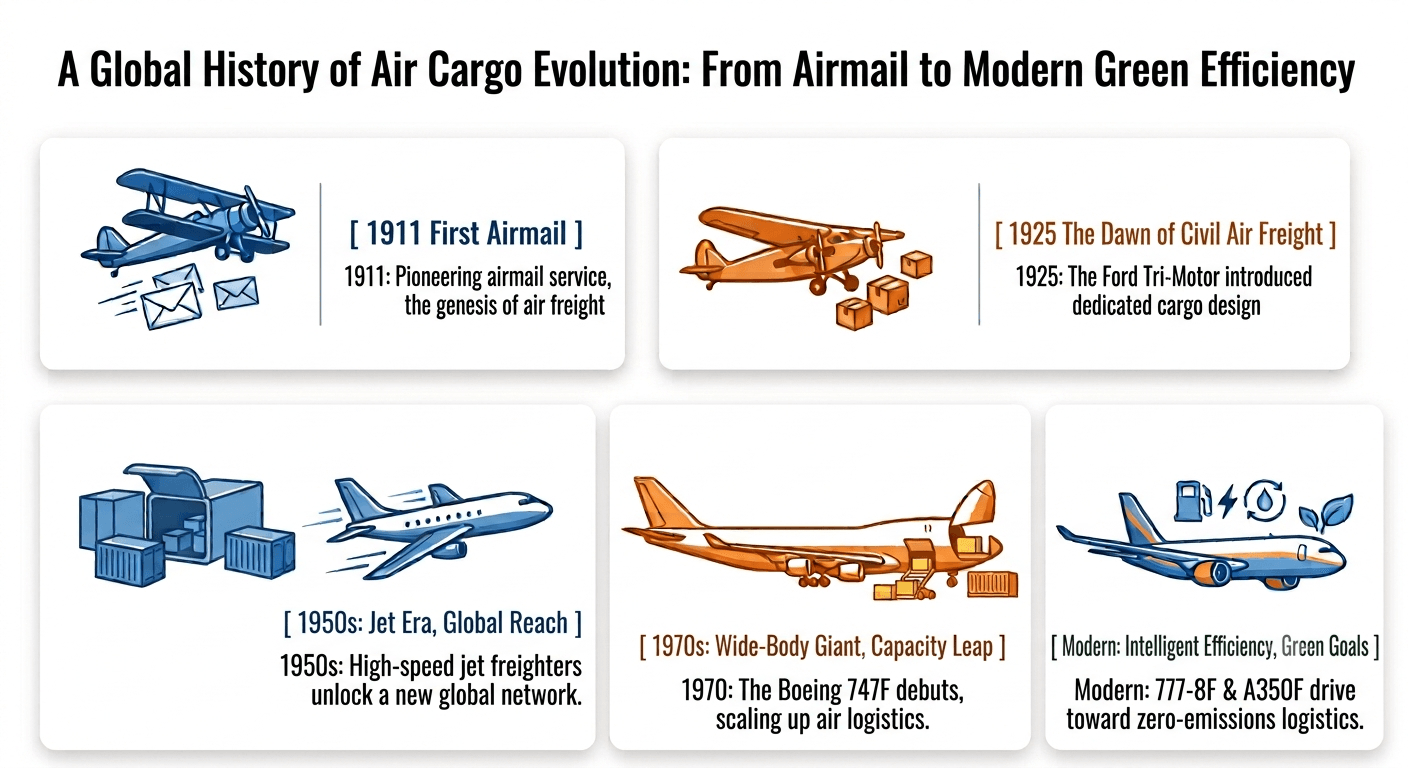
From Propellers to Jets: Key Evolution Stages
Four major eras define how cargo aircraft advanced in speed, capacity, and efficiency.
Propeller Era (1920s–1950s) Early freighters were mostly converted military or passenger models. They offered limited speed and payload by today’s standards.
Jet Age (1950s–present) Jet engines allowed higher altitudes, longer ranges, and faster transit. Iconic models included the Boeing 707 Freighter and Douglas DC-8 Freighter.
Wide-body Revolution (1970s–present) The Boeing 747 Freighter transformed capacity. Nose-loading and massive volume made global bulk air freight practical.
Modern Efficiency Era Current focus sits on fuel burn, emissions, and payload. Boeing 777 Freighter and upcoming A350F lead this shift.
Why No Airbus A380 Freighter Exists
Design choices optimized for passengers limit the A380’s cargo potential.
Three main reasons explain the absence of a dedicated freighter version:
Volume-versus-weight mismatch – the aircraft reaches structural payload limits before filling its large cabin volume.
Limited operational flexibility – its size restricts access to many secondary cargo airports.
Hub-centric design – passenger-focused routes do not align with typical cargo origin and distribution patterns.
Smaller, more versatile freighters remain preferred by most operators.
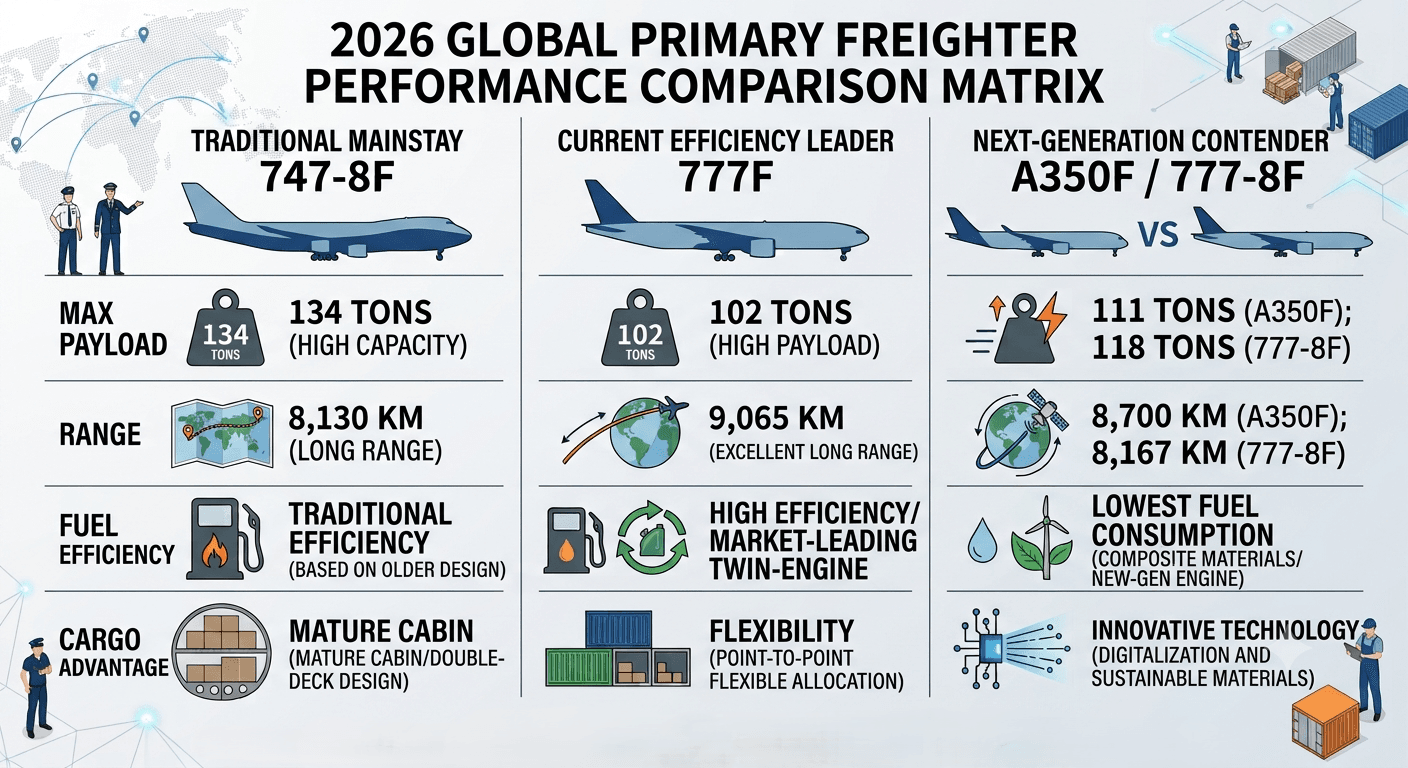
Top Cargo Aircraft Comparison Table 2026
Payload, range, and status help shippers choose the right freighter.
Aircraft
Max Payload (approx.)
Status in 2026
Key Strength
Antonov An-124
~150 tonnes
In service (outsize)
Oversized cargo
Boeing 747-8F
~134 tonnes
In service
Volume + nose loading
Boeing 777F
~102–103 tonnes
Production ending late 2026
Efficiency & range
Airbus A350F
~111 tonnes
Entry expected late 2027
Fuel efficiency
Boeing 767-300F
~52–54 tonnes
In service
Medium-haul reliability
Data reflects manufacturer and industry figures; real-world loads vary with fuel and route.
Future Trends Shaping Cargo Aviation
Sustainability, automation, and flexibility drive the next generation of freighters.
Key directions include:
Greater fuel efficiency and lower emissions through advanced materials and aerodynamics.
Growing use of autonomous systems and AI for flight and ground operations.
Wider adoption of sustainable aviation fuels and early electric propulsion on short routes.
Designs that allow rapid conversion between passenger and cargo configurations.
Fleet forecasts show continued growth, especially in medium and narrow-body segments through 2035.
FreightAmigo’s Role in Modern Air Cargo
Digital platforms turn complex air-freight decisions into simple, transparent workflows.
FreightAmigo combines AI, big data, FreighTech, FinTech, InsurTech, and GreenTech into one ecosystem.
Automate documentation and receive 24×7 expert support.
The result is faster decisions, lower risk, and better cost control for every shipment.
Frequently Asked Questions
When were the first cargo planes invented?
Dedicated cargo aircraft began appearing in the 1920s and 1930s, following early air-mail experiments in 1911 and regular U.S. airmail service in 1918. The Ford Trimotor and later DC-3 marked important early commercial steps.
How fast do modern cargo planes fly in 2026?
Wide-body freighters typically cruise between 550 and 610 mph. Narrow-body jets reach 500–570 mph, while turboprops stay around 250–300 mph. Operators often fly below maximum speed for better fuel efficiency.
What is the largest cargo plane still flying in 2026?
Among production freighters the Boeing 747-8F leads with about 134 tonnes of payload. The Antonov An-124 remains the primary option for outsized loads up to roughly 150 tonnes.
Why is there no cargo version of the Airbus A380?
The A380’s passenger-optimized design reaches weight limits before filling its volume. Its size also restricts airport access and flexibility compared with more versatile freighters preferred by cargo operators.
How has cargo aircraft technology improved since the 1970s?
The 747 introduced high-volume wide-body capacity. Later twin-engine freighters such as the 777F improved fuel burn and range. Newer designs emphasize sustainability, lower emissions, and digital integration.
What future trends will shape cargo planes after 2026?
Expect continued focus on sustainable aviation fuels, greater automation, electric or hybrid options for short routes, and flexible designs that switch easily between passenger and cargo roles.
Which freighter offers the best balance of capacity and efficiency in 2026?
The Boeing 777F currently balances payload near 102 tonnes with strong fuel efficiency and range. The upcoming Airbus A350F aims to improve efficiency further once it enters service.
How can shippers optimize air cargo costs today?
Use digital platforms to compare real-time rates across carriers, choose the right aircraft type for the shipment profile, and consolidate documentation and insurance in one place to reduce handling time and risk.
Conclusion: The Sky’s the Limit in 2026
Cargo aviation has progressed from early mail flights to high-capacity, efficient freighters that power global commerce.
Continued innovation in efficiency, sustainability, and digital tools will keep expanding what is possible.
FreightAmigo stands ready to help businesses navigate this evolving landscape with transparent pricing, real-time visibility, and end-to-end support.
Whether moving documents, parcels, or heavy freight, the right combination of modern aircraft and smart logistics platforms delivers results.
For expert guidance, Book a Demo with FreightAmigo.
Dedicated cargo planes emerged in the 1920s and 1930s. Early milestones included 1911 air mail in India, 1918 U.S. airmail service, the 1925 Ford Trimotor with cargo capacity, and 1930s cargo use of the Douglas DC-3.
How fast does a cargo plane go?
Speeds vary by type and can reach about 550-610 mph for wide-body jets. Turboprops fly 250-300 mph and narrow-body jets 500-570 mph, often slightly below maximum for better fuel efficiency.
How did cargo aircraft evolve from propellers to jets?
Progression moved from propeller planes through jets and wide-bodies to modern efficiency focus. Propellers dominated the 1920s-1950s, jets from the 1950s enabled faster farther flights, and 1970s wide-bodies like the 747 sharply raised capacity.
Why is there no dedicated cargo version of the Airbus A380?
Design limits and market needs make an A380 freighter uneconomical. Passenger-optimized volume hits payload weight first, operators prefer flexible smaller aircraft, and its hub strategy mismatches typical cargo flows.
What trends are shaping the future of cargo aviation?
Future planes will stress efficiency, autonomy, alternative fuels, and versatility. Advances include lower-emission materials and propulsion, possible unmanned AI flights, sustainable fuels or electric options, and quick passenger-freight conversions.
What defined the wide-body revolution in cargo aircraft?
1970s wide-body freighters dramatically boosted capacity and range. The Boeing 747 Freighter and similar models carried far more freight over longer distances and transformed global logistics.
How does FreightAmigo support modern air cargo logistics?
FreightAmigo provides a digital one-stop platform for air cargo efficiency. It lets users compare and book quotes, track shipments, arrange customs insurance and finance, automate documents, and access 24x7 expert support.





















 Global Popular RoutesTop sea & air shipping lanes
 Special OfferLimited-time shipping promotions


 Express
 Document
 Parcel - Air/Sea
 Container
 Relocation