Top 10 Ports in Africa 2026: Complete Guide to International Trade Gateways
Why Africa's Ports Matter for Global Trade in 2026
Africa's port network is undergoing the most significant expansion in its history, making 2026 a pivotal year for businesses seeking cost-efficient access to one of the world's fastest-growing trade regions. With intra-African trade volumes projected to accelerate under the African Continental Free Trade Area (AfCFTA) agreement, understanding which ports to use — and how — directly impacts your bottom line.
From the coal terminals of Richards Bay to the Red Sea gateway of Djibouti, each major African port offers a distinct strategic advantage. Choosing the wrong entry point can add days to transit times and thousands of dollars to logistics costs.
This guide covers all 10 of Africa's most critical international trade ports, with actionable data for importers, exporters, freight forwarders, and supply chain managers operating in 2026.
Port of Durban, South Africa — Africa's Busiest Port
The Port of Durban is unquestionably Africa's highest-volume port and the dominant logistics hub for the entire Southern African region. Handling over 880 ships per month on average, Durban processes more container TEUs than any other port on the continent.
Key operational highlights for 2026:
59+ berths capable of accommodating vessels of all sizes
Handles over 880 ships per month on average
Direct strategic rail and road links to South Africa's major industrial corridors
Active capacity expansion projects underway to meet growing AfCFTA demand
Primary gateway for imports and exports to the Southern African Development Community (SADC)
Durban's continuous infrastructure investment makes it the default choice for businesses targeting Southern Africa. Its high throughput, combined with multimodal inland connectivity, gives shippers reliable predictability in transit planning.
Port of Richards Bay, South Africa — Global Bulk Cargo Leader
The Port of Richards Bay holds the distinction of operating the world's largest coal export terminal, making it the undisputed global benchmark for bulk commodity handling. Located approximately 180km north of Durban, it has transformed over 40 years from a small fishing settlement into one of Africa's most specialized industrial ports.
Why Richards Bay matters to bulk cargo shippers:
Hosts the world's largest coal export terminal by volume
Over 40 years of uninterrupted operational history
Specialized infrastructure for bulk minerals, metals, and agricultural commodities
Deep-draft berths capable of handling cape-size bulk carriers
Integrated rail connections to South Africa's mining heartland
For businesses in bulk commodity trading — particularly coal, ferrochrome, aluminium, and woodchip — Richards Bay delivers infrastructure and scale that no other African port can match.
Port of Mombasa, Kenya — East Africa's Premier Gateway
The Port of Mombasa is the single most strategically important port in East Africa, functioning as the primary maritime entry point for five nations simultaneously. Established in 1980 and continuously expanded, Mombasa handles cargo not just for Kenya but for Uganda, Rwanda, Burundi, and significant portions of the Democratic Republic of Congo.
What makes Mombasa indispensable in 2026:
Primary port serving Kenya, Uganda, Rwanda, Burundi, and parts of DR Congo
High-volume container throughput driven by regional landlocked country demand
Standard Gauge Railway (SGR) connectivity to Nairobi and onward inland routes
Continuous berth expansion and modernization programs
Strategic Indian Ocean positioning for Asia-Africa trade lanes
For freight forwarders managing multi-country East African distribution, Mombasa's inland connectivity via the SGR is a game-changing efficiency advantage over road-only alternatives.
Port of Dar es Salaam, Tanzania — Central Africa's Rising Hub
The Port of Dar es Salaam is Tanzania's economic anchor and one of the most consequential ports for Central Africa's landlocked trade corridors. Positioned as a direct competitor to Mombasa for regional cargo, Dar es Salaam has undergone aggressive modernization to attract more international shipping lines and increase container throughput.
Key advantages of routing through Dar es Salaam:
Primary maritime gateway for Tanzania's rapidly growing economy
Serves landlocked nations including Zambia, Malawi, DRC, and Burundi
TAZARA and TANZAM rail links provide inland reach into Central Africa
Ongoing berth deepening to accommodate larger modern vessels
Competitive port tariffs relative to regional alternatives
Businesses shipping to Central Africa should actively evaluate Dar es Salaam against Mombasa based on final destination, transit time, and total landed cost.
Port of Beira, Mozambique — The Landlocked Nations' Lifeline
The Port of Beira is the most critical maritime lifeline for three of Africa's most import-dependent landlocked economies: Zimbabwe, Malawi, and Zambia. Its geographic position on Mozambique's central coast provides the shortest sea-to-inland distance for cargo destined for these countries.
Beira's multimodal infrastructure includes:
Direct road and rail corridors to Zimbabwe, Malawi, and Zambia
Established sea routes connecting to Europe, Asia, and the Middle East
Multiple berth types handling general cargo, bulk commodities, containers, and fishing vessels
The Beira Corridor — one of Africa's most strategically important freight corridors
Active dredging and channel deepening projects to accommodate larger vessels
For importers serving Zimbabwe or Zambia, Beira consistently delivers shorter inland transit times than routing through Durban or Dar es Salaam — a cost advantage that compounds significantly at volume.
Port of Djibouti — The Red Sea's Strategic Chokepoint
The Port of Djibouti commands one of the most geopolitically significant positions of any port in the world, sitting at the entrance to the Red Sea where over 20,000 vessels transit annually. Its role as the primary gateway for landlocked Ethiopia — Africa's second most populous nation — gives it outsized economic importance in 2026.
Why Djibouti is essential for East African trade:
Direct rail connection to Addis Ababa, serving Ethiopia's 120+ million consumers
Serves over 40 international shipping lines with regular port calls
Recognized for operational efficiency relative to regional competitors
High demand frequently requires advance booking — plan 2–4 weeks ahead
Transshipment hub for Horn of Africa cargo distribution
Businesses entering the Ethiopian market must treat Djibouti as their default gateway. Delays caused by late booking are the most common — and most avoidable — disruption for shippers using this port.
Suez Canal Container Terminal, Egypt — Global Maritime Crossroads
The Suez Canal Container Terminal (SCCT) represents Egypt's most powerful asset in the global container shipping network, positioned at the junction where approximately 12% of global trade passes annually. Though relatively newer compared to historic African ports, it has rapidly become one of the Mediterranean's most sought-after transshipment hubs.
SCCT's competitive advantages in 2026:
Leverages the Suez Canal's irreplaceable global shipping lane position
State-of-the-art terminal equipment and operational systems
Major international shipping alliances call SCCT as a primary port of call
Significant ongoing investment from global terminal operators
Strategic positioning for Europe-Asia cargo transshipment
For global shippers, SCCT offers the rare combination of strategic geography and modern terminal efficiency — reducing transshipment dwell times for cargo moving between Europe, Asia, and East Africa.
Port of Lagos, Nigeria — West Africa's Trade Engine
The Port of Lagos is the most complex and highest-volume port complex in West Africa, functioning as the commercial heartbeat for Nigeria — the continent's largest economy by GDP. Unlike other African ports, Lagos operates as a multi-port system spread across three distinct operational zones.
Lagos port complex structure:
Lagos Port — handles general cargo and container traffic
Tin Can Island Port — specialized container terminal with deep-draft berths
Apapa Port — Nigeria's largest and most historic port facility
Serves Nigeria, Benin, Niger, Cameroon, Chad, and beyond
Home to the Marina Transport Academy, one of Africa's foremost maritime training institutions
Lagos's complexity demands experienced logistics partners. Congestion, documentation requirements, and multi-terminal coordination make professional freight management essential for businesses new to West African trade.
Port of Walvis Bay, Namibia — Southwest Africa's Business-Friendly Alternative
The Port of Walvis Bay has emerged as one of Africa's most compelling alternatives for shippers seeking a less congested, business-friendly gateway into the southwestern region of the continent. Its reputation for operational efficiency and transparent port procedures makes it particularly attractive to first-time entrants into African markets.
Walvis Bay's competitive strengths include:
Primary maritime gateway for all of Namibia's import and export activity
Significantly lower congestion levels compared to Durban or Lagos
Business-friendly regulatory environment with streamlined customs procedures
Growing infrastructure investments positioning it as a regional transshipment hub
Access to the Trans-Kalahari Corridor linking to Botswana and South Africa
For businesses exploring Namibia or seeking an uncongested West African entry point, Walvis Bay delivers reliable dwell times and competitive handling costs that larger ports often cannot match.
Port of Saldanha Bay, South Africa — Africa's Established Deep-Water Giant
The Port of Saldanha Bay has served as one of Africa's most capable deep-water ports since the 1970s, and ongoing modernization ensures it remains competitive for the demands of 2026's global trade environment. Its natural deep-water harbor requires minimal dredging, making it uniquely suited for large bulk carriers and tankers.
Saldanha Bay's enduring advantages:
One of Africa's deepest natural harbors — handles cape-size and VLCC vessels
Established iron ore export terminal with decades of operational history
Active modernization programs to attract new cargo types and shipping lines
Serves as a gateway to Europe, Americas, and Asia via established shipping lanes
Strategic position on South Africa's west coast, separate from Durban's congestion
Saldanha Bay is the preferred choice for iron ore exporters and businesses requiring large-vessel capacity without competing for berth space at South Africa's busier eastern ports.
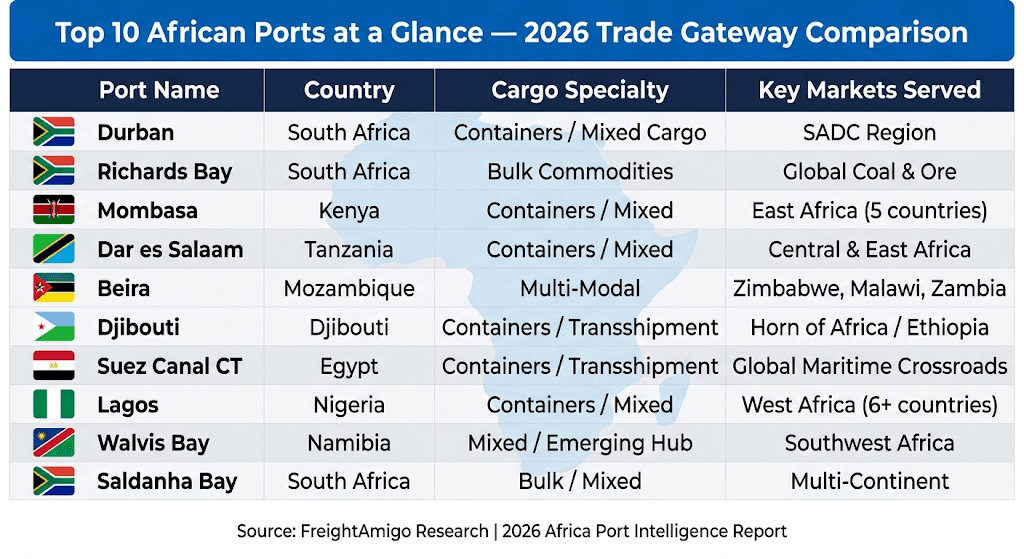
Africa's Top 10 Ports: Full Comparison Table 2026
Selecting the right African port requires comparing multiple operational variables simultaneously — this table consolidates the critical data for all 10 major gateways. Use this as your quick-reference decision matrix.
Port
Country
Primary Cargo
Key Inland Markets
Berths
Congestion Level
Best For
Durban
South Africa
Containers, Mixed
SADC Region
59+
High
High-volume importers/exporters
Richards Bay
South Africa
Bulk Commodities
SA Mining Belt
Multiple bulk
Medium
Coal, ore, mineral exporters
Mombasa
Kenya
Containers, Mixed
Kenya, Uganda, Rwanda, Burundi, DRC
20+
High
East African distribution
Dar es Salaam
Tanzania
Containers, Mixed
Tanzania, Zambia, Malawi, DRC
11+
Medium-High
Central Africa routing
Beira
Mozambique
Multi-Modal
Zimbabwe, Malawi, Zambia
7+
Medium
Landlocked SADC country access
Djibouti
Djibouti
Containers, Transshipment
Ethiopia, Horn of Africa
15+
High
Ethiopia market entry
Suez Canal CT
Egypt
Containers, Transshipment
Global / Mediterranean
16+
Medium
Europe-Asia-Africa transshipment
Lagos
Nigeria
Containers, Mixed
West Africa (6+ countries)
30+
Very High
West African market access
Walvis Bay
Namibia
Mixed, Growing
Namibia, Botswana, SW Africa
13+
Low-Medium
First-time Africa market entry
Saldanha Bay
South Africa
Bulk, Deep-Water
Multi-Continent
7+
Low
Iron ore, large vessel operations
2026 Planning Note: Congestion levels at Durban and Lagos are expected to remain elevated through 2026 due to AfCFTA trade volume growth. Build buffer time into all schedules using these ports.
Frequently Asked Questions
What is the busiest port in Africa in 2026?
The Port of Durban in South Africa remains Africa's busiest port in 2026, handling over 880 ships per month across 59+ berths. It processes more container TEUs than any other African port and serves as the primary logistics hub for the Southern African Development Community (SADC).
Which African port handles the most bulk cargo?
The Port of Richards Bay in South Africa handles the most bulk cargo of any African port, home to the world's largest coal export terminal. It specializes in bulk minerals, coal, aluminium, and agricultural commodities with deep-draft berths for cape-size vessels.
What is the main port for East Africa?
The Port of Mombasa in Kenya is East Africa's primary port, serving as the main maritime gateway for Kenya, Uganda, Rwanda, Burundi, and parts of the Democratic Republic of Congo. Its Standard Gauge Railway connection to Nairobi significantly enhances inland cargo distribution efficiency.
Which African port is best for shipping to Ethiopia?
The Port of Djibouti is the best and most practical gateway for shipping to Ethiopia, connected directly to Addis Ababa via rail. Over 40 international shipping lines serve Djibouti, but advance booking of 2–4 weeks is strongly recommended due to consistently high demand.
How many ports does Nigeria have?
Nigeria's primary port complex in Lagos comprises three main facilities: Lagos Port, Tin Can Island Port, and Apapa Port. Together, these form West Africa's largest port complex, serving Nigeria and neighboring countries including Benin, Niger, Cameroon, and Chad.
What is the best African port for landlocked countries?
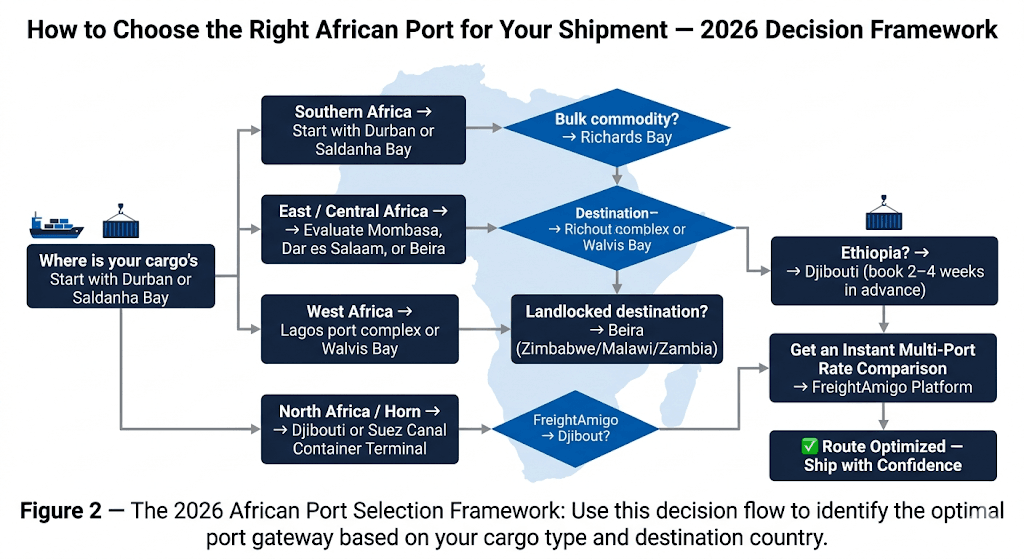
The best port for landlocked countries depends on location. Beira (Mozambique) serves Zimbabwe, Malawi, and Zambia most efficiently. Mombasa and Dar es Salaam serve Uganda, Rwanda, Burundi, and DRC. Djibouti is optimal for landlocked Ethiopia. Each offers dedicated road and rail inland corridors.
Is Walvis Bay a good alternative to Durban?
Yes, Walvis Bay is an excellent alternative to Durban for shipments destined for Namibia, Botswana, and southwestern Africa. It offers significantly lower congestion levels, streamlined customs procedures, and competitive handling costs — making it particularly attractive for first-time African market entrants.
How can FreightAmigo help with African port logistics?
FreightAmigo's Digital Logistics Platform provides instant freight rate comparisons across all major African ports, real-time shipment tracking, customs clearance assistance, and 24/7 expert logistics support. Businesses can compare routing options between ports like Mombasa vs. Dar es Salaam to optimize total landed cost.
What documentation is required for shipping through African ports?
Standard documentation for African port shipments typically includes a Bill of Lading or Air Waybill, Commercial Invoice, Packing List, Certificate of Origin, and import/export permits specific to each country. Some nations require additional certificates such as phytosanitary certificates for agricultural goods or conformity certificates for regulated products.
Conclusion: Optimize Your African Port Strategy with FreightAmigo in 2026
Africa's 10 major international ports each represent a distinct strategic opportunity — and choosing correctly between them is one of the highest-leverage decisions in your supply chain. The difference between routing through Beira versus Dar es Salaam for Zambia-bound cargo, or choosing Walvis Bay over Lagos for southwestern distribution, can mean days of transit time and significant cost savings at scale.
At FreightAmigo, our Digital Logistics Platform is purpose-built to help businesses make data-driven port selection decisions across Africa's entire maritime network. Our platform delivers:
Cargo insurance integrated directly into the booking workflow
Trade finance solutions for high-volume African import/export programs
24/7 expert logistics support from specialists with deep African market knowledge
Whether you're a first-time importer exploring Walvis Bay's business-friendly environment or an established exporter managing high-volume container flows through Durban and Lagos, FreightAmigo has the tools, expertise, and network to optimize every shipment.
Africa's trade opportunity in 2026 is unprecedented. The businesses that win will be those that move with speed, intelligence, and the right logistics partner.
For expert guidance, Book a Demo with FreightAmigo.








 Global Popular RoutesTop sea & air shipping lanes
 Special OfferLimited-time shipping promotions





 Express
 Document
 Parcel - Air/Sea
 Container
 Relocation