Understanding CBM Cubic Meter in Shipping: Complete 2026 Guide
What Is CBM in Shipping and Why It Matters in 2026
CBM, or cubic meter, measures the space your cargo occupies and remains the core driver of freight charges across ocean, air, and road modes in 2026.
One CBM equals a cube measuring 1 meter on every side, or roughly 35.3 cubic feet. Carriers use this volume metric because space is limited and often more valuable than pure weight.
In 2026, tighter vessel utilization, sustainability rules, and dynamic pricing make accurate CBM critical. Incorrect measurements lead to unexpected surcharges, delayed customs clearance, or rejected bookings.
Key facts about CBM today:
1 CBM = 1,000 liters
Essential for LCL ocean freight billing
Converts to volumetric weight in air freight
Affects truck loading efficiency on road legs
Required on most commercial invoices and packing lists
Shippers who master CBM gain better rate predictability and higher load density.
How to Calculate CBM Step by Step for 2026 Shipments
Calculating CBM is straightforward: multiply length by width by height in meters for each package, then add the totals.
Always measure the outermost dimensions, including any protrusions or packaging. Convert centimeters or inches first if your measuring tools use different units.
Follow these exact steps:
Measure the longest length, widest width, and tallest height of each carton or pallet in centimeters or meters.
Convert all measurements to meters (divide cm by 100).
Multiply Length × Width × Height for each item.
Add every individual CBM figure to get the shipment total.
Round up according to the carrier’s policy (most round to two or three decimal places).
Example: A carton measuring 1.2 m × 0.8 m × 1.0 m equals 0.96 CBM. Three identical cartons total 2.88 CBM.
For irregular shapes, use the maximum dimensions that form a rectangular box around the item.
CBM vs Actual Weight: Chargeable Weight Rules Explained
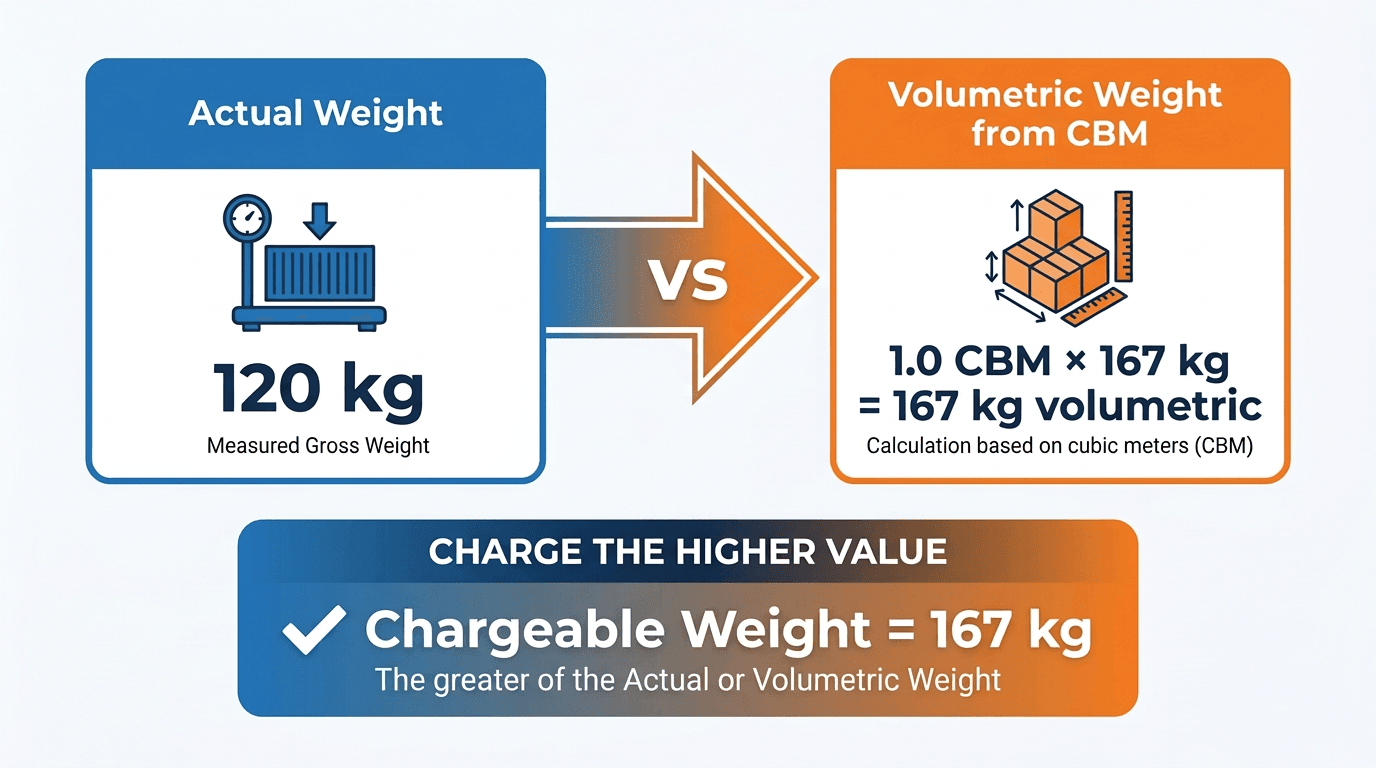
Carriers always bill the higher of actual weight or volumetric weight calculated from CBM.
This “chargeable weight” rule protects airlines and ocean carriers from low-density cargo that fills space without paying its share.
Volumetric conversion factors used in 2026:
Air freight: 1 CBM = 167 kg
Ocean LCL: charged directly per CBM (or minimum)
Road freight: often 1 CBM = 333 kg in many regions
Shipping Mode
Volumetric Factor
Chargeable Rule
Typical Use Case
Ocean LCL
Direct CBM
Higher of CBM or weight minimum
Consolidated shipments
Air Freight
167 kg per CBM
Higher of actual or volumetric kg
Time-sensitive light cargo
Road / Truck
333 kg per CBM
Higher of actual or volumetric kg
Domestic or cross-border trucking
FCL Ocean
N/A (full container)
Flat rate per container
High-volume dense cargo
Always calculate both figures before booking so you know the true cost.
2026 Container CBM Capacities Comparison Table
Standard ISO containers have fixed internal volumes, but usable CBM is lower once packing and weight limits are applied.
Use these realistic 2026 figures when planning FCL or estimating LCL space.
Container Type
Internal CBM
Usable CBM (typical)
Max Payload (kg)
Best For
20ft Standard
33.2
26–28
28,000
Dense or heavy cargo
40ft Standard
67.7
55–58
28,000–30,480
General merchandise
40ft High Cube
76.4
65–68
28,000–30,480
Light bulky goods
45ft High Cube
86.0
75–78
28,500
Maximum volume needs
Always leave space for bracing and air circulation. Overpacking can damage cargo and trigger extra handling fees.
Ocean Freight CBM Pricing Impact in 2026
In ocean freight, CBM directly determines LCL rates and influences FCL utilization efficiency.
LCL shipments are priced per CBM plus a minimum charge. FCL is a flat container rate, yet higher density still improves your cost per unit.
Current 2026 cost drivers include:
Base ocean rate quoted per CBM for LCL
Bunker adjustment and low-density surcharges
Port congestion fees that scale with volume
Green fuel or carbon levies linked to space occupied
Peak-season multipliers applied to CBM totals
Shippers who reduce CBM by 15–20% through better packing often cut total landed costs significantly.
Air Freight Volumetric Weight and CBM in 2026
Air carriers convert CBM into kilograms using the IATA standard of 167 kg per cubic meter.
Light, bulky items such as furniture, apparel, or electronics packaging frequently pay more for space than for actual weight.
Best practices for 2026 air shipments:
Measure every package at its longest points
Avoid oversized outer cartons
Use vacuum or compression packing where possible
Confirm ULD (unit load device) CBM limits with the airline
Account for possible dimensional weight audits at origin
Accurate CBM prevents invoice surprises after the cargo has already flown.
Practical Ways to Optimize CBM and Lower Shipping Costs
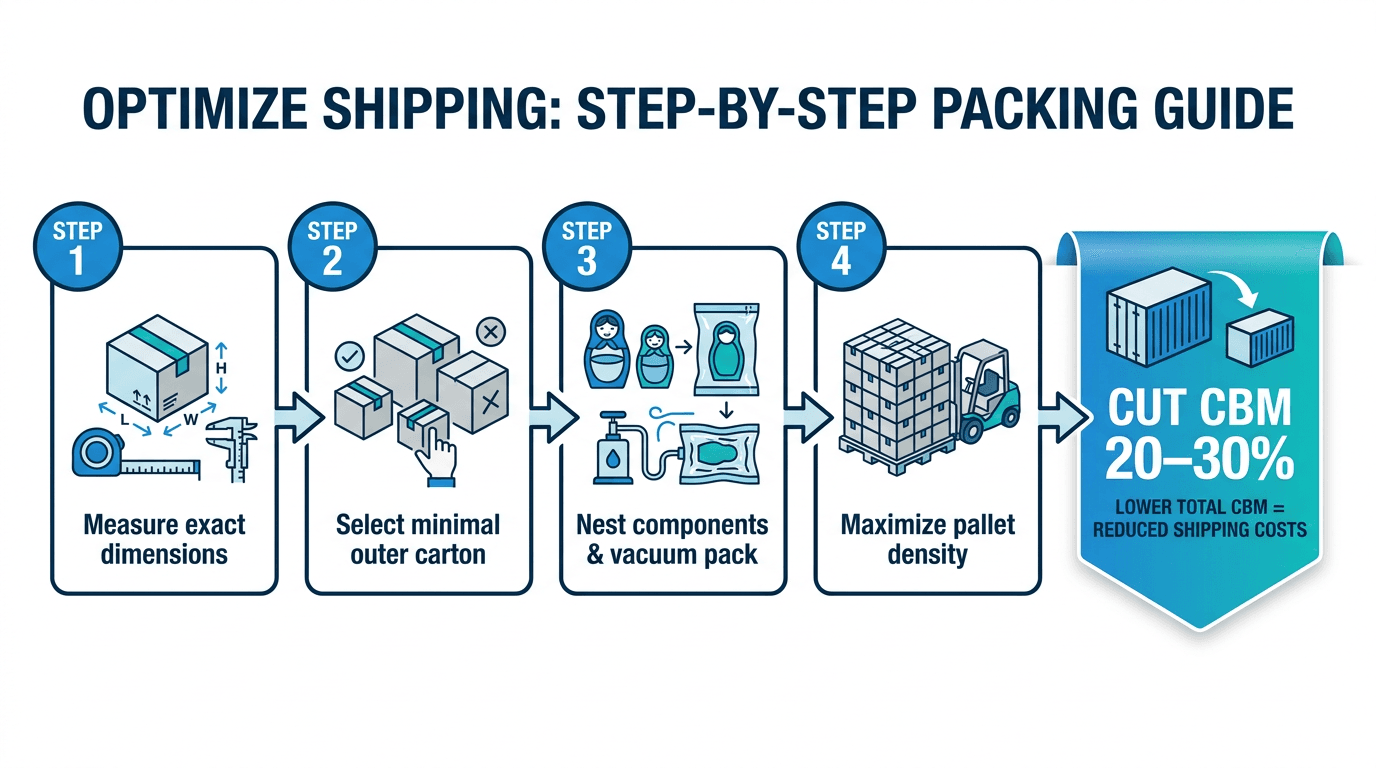
Reducing total CBM without sacrificing product protection is the fastest way to lower freight spend in 2026.
Apply these proven tactics:
Select the smallest carton that still meets strength requirements.
Disassemble products and nest components before packing.
Use flat-pack or collapsible designs whenever possible.
Stack cartons efficiently on pallets to eliminate wasted air space.
Consolidate multiple small orders into fewer larger packages.
Test packing configurations with 3D software or physical mock-ups.
Many e-commerce and manufacturing firms now achieve 20–30% CBM reductions and corresponding cost savings.
Common CBM Challenges and Solutions for 2026 Logistics
Even experienced shippers face CBM-related issues caused by new scanning technology, sustainability rules, and fluctuating capacity.
Frequent problems and practical fixes:
Dimensional scanners at terminals catch under-declared CBM → always measure twice and document photos
Eco-friendly packaging sometimes increases volume → balance protection with density
Customs require precise CBM on declarations → include CBM on every commercial invoice and packing list
Irregular or odd-shaped cargo → use rectangular outer packaging or foam boxing
Last-minute booking changes → recalculate CBM immediately before confirmation
Digital tools and freight forwarder support help most companies stay accurate.
FAQ
What does CBM mean in shipping?
CBM stands for cubic meter and measures the volume of cargo. It is the standard unit carriers use to calculate space-based freight charges for ocean, air, and road shipments.
How do I calculate CBM for my shipment?
Multiply the length, width, and height of each package in meters, then add the results. Convert centimeters to meters by dividing by 100 before multiplying.
What is the difference between CBM and chargeable weight?
CBM is pure volume. Chargeable weight is the higher of the actual scale weight or the volumetric weight derived from CBM using the carrier’s conversion factor.
How many CBM fit in a 20-foot container?
A standard 20-foot container has about 33 CBM internal volume, but usable space is typically 26–28 CBM after allowing for packing and weight limits.
Why do air freight rates use CBM?
Airlines convert CBM into volumetric kilograms (usually 167 kg per CBM) so that bulky light cargo pays fairly for the aircraft space it occupies.
Can I reduce my shipping costs by lowering CBM?
Yes. Better packing, nesting, and carton selection often cut total CBM by 15–30%, which directly lowers LCL and air freight bills.
Does CBM matter for full container loads (FCL)?
FCL is charged per container, yet higher CBM utilization still improves your cost per unit and helps avoid low-density surcharges in some trades.
What happens if I declare the wrong CBM?
Carriers or terminals may re-measure and issue a correction invoice, plus possible fines or delays. Accurate measurement prevents these extra costs.
Final Tips for Mastering CBM Calculations in 2026
Accurate CBM measurement, smart packing, and clear documentation remain the foundation of cost-effective global shipping in 2026.





















 Global Popular RoutesTop sea & air shipping lanes
 Special OfferLimited-time shipping promotions


 Express
 Document
 Parcel - Air/Sea
 Container
 Relocation