Understanding CBM Meaning and Its Critical Role in Freight Costs
Want To Compare The Best Express, Air Freight, Sea Freight, Rail Freight & Trucking Rates So As To Have Better Control On Cost?
The Significance of CBM in Logistics
In the world of international shipping and logistics, understanding the meaning of CBM (Cubic Meter) is crucial for businesses looking to optimize their freight costs. As a key factor in determining shipping rates, CBM plays a vital role in the efficiency and cost-effectiveness of your supply chain. In this article, we'll explore the importance of CBM in freight costs and how FreightAmigo's digital logistics platform can help you navigate this complex aspect of shipping. Key points we'll cover:
The meaning of CBM and its calculation
How CBM affects freight costs
The importance of accurate CBM measurements
How FreightAmigo's digital logistics solution can optimize your shipping process
What is CBM?
CBM, which stands for Cubic Metre (or Cubic Meter), is the universal standard unit of volume measurement used by freight carriers, forwarders, and customs authorities worldwide to price and plan cargo shipments.
In plain terms, one CBM equals the space occupied by a box that is exactly 1 metre long × 1 metre wide × 1 metre tall. Every carrier — whether ocean, air, or road — uses CBM to decide how much space your cargo takes up in a vessel, aircraft, or truck.
As global trade volumes continue to surge in 2026, precise CBM literacy is no longer optional for businesses. It is a core commercial skill that directly affects profit margins.
Full Container Load (FCL): Standard 20-foot container = ~25–28 CBM usable space
40-foot container: ~55–58 CBM usable spacespace
40-foot High Cube: ~66–68 CBM usable spacespace
Less than Container Load (LCL): Charged per CBM or per tonne, whichever is greaterspace
Air freight: Volume weight (CBM × 167 kg) vs. actual weight determines billing
The CBM Formula: How to Calculate Cubic Meters Accurately
Calculating CBM correctly is the single most important step to avoid surprise freight surcharges and ensure accurate shipping quotes.
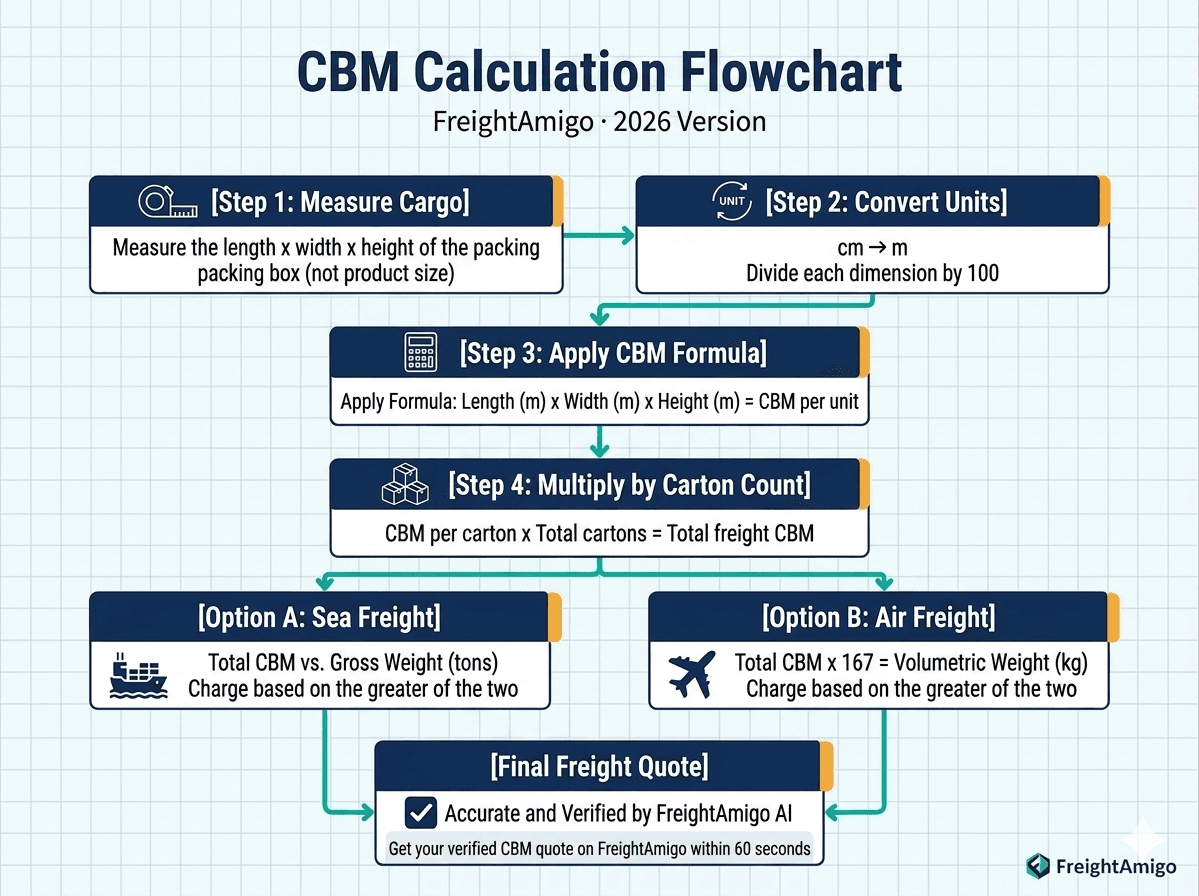
The core formula is straightforward — but the details matter enormously. Always measure the outer dimensions of the packed carton or pallet, not the product itself.
CBM = Length (m) × Width (m) × Height (m)
Step-by-Step CBM Calculation Example
Measure each carton: Length = 1.2 m, Width = 0.8 m, Height = 0.9 m
Multiply the three dimensions: 1.2 × 0.8 × 0.9 = 0.864 CBM per carton
Multiply by total carton count: 0.864 × 50 cartons = 43.2 CBM total
Compare to gross weight: 43.2 CBM × 1,000 kg/CBM = 43,200 kg volumetric weight
Carrier bills the higher: Actual gross weight vs. volumetric weight
If your dimensions are in centimetres, convert first: divide each measurement by 100 before multiplying. For example, 120 cm × 80 cm × 90 cm = 1.2 m × 0.8 m × 0.9 m.
The Impact of CBM on Freight Costs
CBM plays a significant role in determining freight costs for several reasons:
1. Space Utilization
Shipping companies charge based on either the actual weight of the cargo or its volumetric weight (calculated using CBM), whichever is greater. This practice ensures that lightweight but bulky items are charged fairly for the space they occupy.
2. Container Loading Efficiency
Accurate CBM measurements help in planning how to load containers efficiently, maximizing the use of available space and potentially reducing the number of containers needed.
3. Mode of Transport Selection
CBM can influence the choice between air, sea, or land freight. For instance, items with high CBM but low weight might be more cost-effective to ship by sea rather than air.
4. Warehousing Costs
Storage fees in warehouses are often based on the space occupied, which is determined by CBM.
Precise CBM calculations are crucial for several reasons:
Avoiding unexpected costs due to underestimated volume
Preventing delays caused by inaccurate space allocation
Optimizing container usage and reducing wasted space
Ensuring compliance with shipping regulations
Facilitating accurate quotes and invoicing
Inaccurate CBM measurements can lead to significant financial implications, making it essential for businesses to prioritize precision in their cargo calculations.
CBM vs. Chargeable Weight: Which Gets You Billed?
Every carrier uses a "higher of two" billing rule: you are charged based on either the actual gross weight or the volumetric (dimensional) weight — whichever produces a larger number.
This is the single most misunderstood aspect of freight pricing, and it consistently catches shippers off guard. Here is a clear comparison across all major shipping modes:
Shipping Mode
Volumetric Divisor
Billing Rule
Best For CBM Range
2026 Avg. Rate/CBM
Ocean LCL
1 CBM = 1 Metric Tonne
Higher of CBM or gross tonne
1 – 15 CBM
USD $35–$75 / CBM
Ocean FCL (20')
~25 CBM capacity
Flat rate per container
15 – 25 CBM
USD $1,200–$2,800 flat
Ocean FCL (40')
~55 CBM capacity
Flat rate per container
25 – 55 CBM
USD $2,000–$4,500 flat
Air Freight
1 CBM = 167 kg (IATA)
Higher of vol. kg or gross kg
Under 1 CBM (dense)
USD $4–$12 / kg (chargeable)
Road (FTL)
1 CBM = 333 kg (typical)
Higher of vol. kg or gross kg
5 – 80 CBM
Route-dependent
Road (LTL)
1 CBM = 333 kg (typical)
Per CBM or pallet space
1 – 10 CBM
Route-dependent
7 Costly CBM Mistakes Shippers Make in 2026
Most freight cost overruns are not caused by bad rates — they are caused by avoidable CBM errors that inflate the billable volume of every shipment.
Here are the seven most expensive mistakes shippers make when dealing with CBM, and how to avoid every one of them:
Measuring the product, not the carton: Always measure the outer dimensions of the packed box, including packaging materials.
Using imperial units without converting: Convert inches to centimetres, then to metres before calculating. 1 inch = 2.54 cm.
Rounding down dimensions: Carriers always round up. A 0.91 m measurement becomes 1.0 m for pricing purposes.
Forgetting pallet height: If your cargo ships on pallets, the pallet thickness (typically 12–15 cm) adds to the total height — and CBM.
Ignoring irregular cargo shapes: Non-rectangular items are measured by their longest bounding dimensions — the "bounding box" rule applies.
Calculating total CBM only once: Restuffing, repacking, or adding last-minute SKUs changes your CBM. Recalculate before finalising the booking.
Not comparing volumetric vs. actual weight: Always run both calculations to know which your carrier will bill — before you commit to a shipping mode.
How FreightAmigo's Digital Logistics Platform Optimizes CBM-Related Processes
At FreightAmigo, we understand the complexities involved in CBM calculations and their impact on freight costs. Our digital logistics platform offers several features to help businesses navigate these challenges effectively:
1. Automated CBM Calculation Tools
Our platform includes built-in calculators that automatically determine the CBM of your shipments based on input dimensions, reducing the risk of human error in calculations.
2. Real-Time Quote Comparisons
With FreightAmigo, you can instantly compare door-to-door freight quotes for various shipping modes, taking into account your cargo's CBM to find the most cost-effective option.
3. Optimized Container Loading Plans
Our advanced algorithms help create efficient loading plans based on CBM, ensuring maximum space utilization and potentially reducing the number of containers needed.
4. Integration with Customs Clearance and Documentation
FreightAmigo's platform seamlessly integrates CBM information into customs documentation and clearance processes, streamlining your international shipping operations.
5. Data Analytics for Continuous Improvement
Our system analyzes historical shipping data, including CBM information, to provide insights that can help you optimize your packaging and shipping strategies over time.
Frequently Asked Questions
The most common CBM questions — answered concisely for busy logistics professionals navigating freight in 2026.
What does CBM stand for in shipping?
CBM stands for Cubic Metre (or Cubic Meter). It is the standard unit of volume used in international freight to measure how much space cargo occupies in a ship, aircraft, or truck.
How do I calculate CBM for multiple cartons?
Calculate CBM for one carton (L × W × H in metres), then multiply by the total number of cartons. For example: 0.5 CBM × 20 cartons = 10 CBM total.
What is the CBM limit for LCL shipments?
There is no hard CBM cap on LCL, but once your shipment exceeds 12–15 CBM, an FCL booking typically becomes more cost-effective. FreightAmigo automatically flags this crossover point.
How does CBM affect air freight pricing?
For air freight, 1 CBM = 167 kg of chargeable weight (IATA standard). If your cargo's volumetric weight (CBM × 167) exceeds its actual weight, you pay the volumetric rate — making air very expensive for bulky light goods.
Can I reduce my CBM to cut freight costs?
Yes. Investing in packaging optimisation — tighter carton sizes, compressed packaging, or flat-pack assembly — directly reduces CBM and freight costs. FreightAmigo's analytics module highlights the most impactful packaging changes.
Conclusion: Mastering CBM for Logistics Success
Understanding the meaning of CBM and its impact on freight costs is crucial for businesses aiming to optimize their supply chain operations. time quote comparisons and optimized container loading plans, empowers businesses to navigate the complexities of international shipping with ease and efficiency. As the logistics landscape continues to evolve, partnering with a forward-thinking digital logistics platform like FreightAmigo can give your business the competitive edge it needs to thrive in the global marketplace.
For expert guidance, Book a Demo with FreightAmigo.








 Global Popular RoutesTop sea & air shipping lanes
 Special OfferLimited-time shipping promotions





 Express
 Document
 Parcel - Air/Sea
 Container
 Relocation