Introduction to Cold Chain Logistics in Healthcare
Cold chain logistics is the invisible infrastructure that keeps life-saving medicines, vaccines and biologics safe — and the stakes have never been higher as the global healthcare cold chain market races toward USD 320.9 billion by 2035.
As we delve into this complex and vital field, we'll explore how digital platforms like FreightAmigo are transforming the landscape of cold chain logistics in healthcare.
The Importance of Temperature Control in Healthcare Logistics
Temperature control is the cornerstone of cold chain logistics in healthcare. Many pharmaceutical products, vaccines, biologics, and diagnostic materials require strict temperature maintenance to preserve their efficacy and safety. Even slight deviations from the prescribed temperature range can render these products ineffective or potentially harmful.
According to industry data, cold chain failures cost the pharmaceutical sector USD 20–35 billion every year, while nearly 50% of vaccines globally are discarded due to improper temperature management.
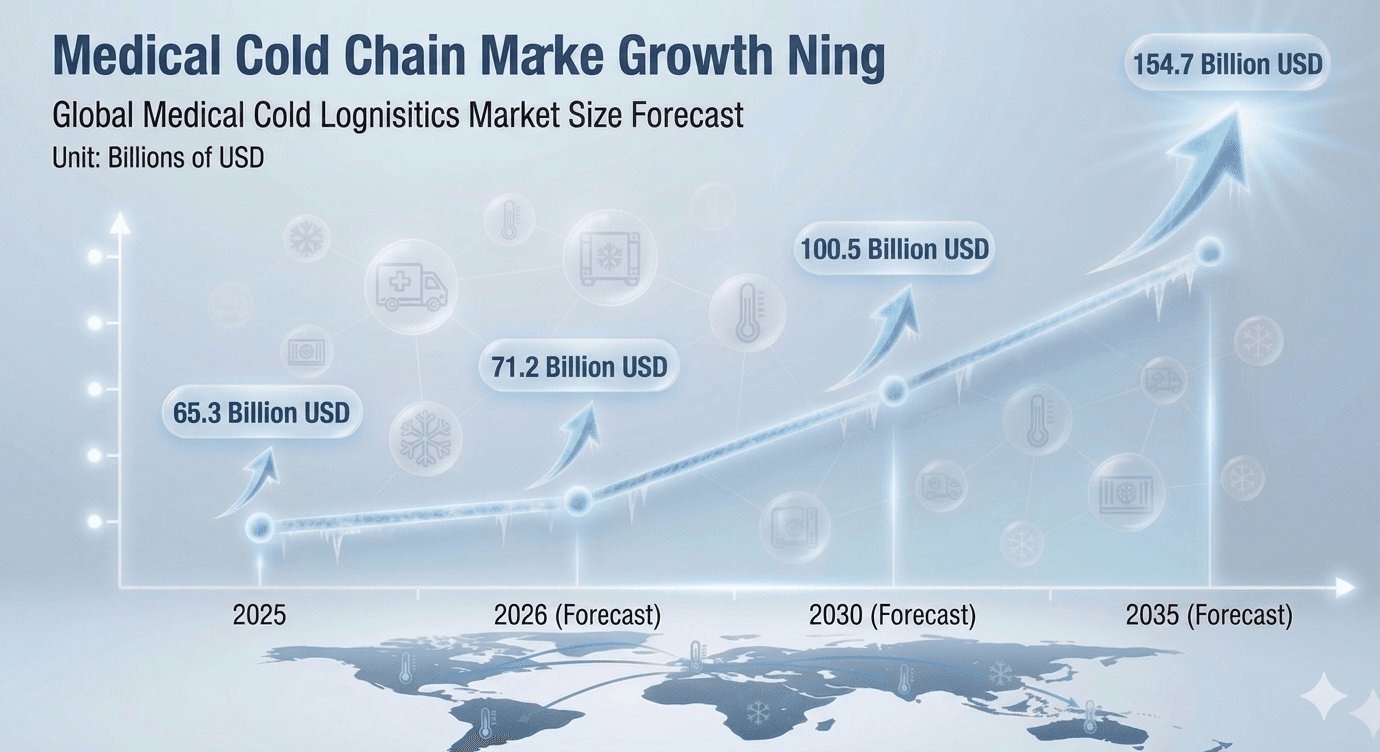
The global medical cold chain logistics market is projected to reach approximately $65 billion by 2025, and is expected to expand rapidly over the next decade at a CAGR of over 9%, primarily driven by surging demand for biologics, mRNA technology, and cell and gene therapies. More than 85% of biologics require specialized cold chain support.
Source: Future Market Insights (2025)
Regulatory Framework: GDP, WHO & FDA Standards
Every healthcare shipment must comply with international and local regulatory standards.
The WHO Model Guidance (Technical Report Series No. 961, Annex 9) sets the global benchmark for Good Distribution Practice (GDP) of time- and temperature-sensitive pharmaceutical products. The EU GDP guidelines (2013/C 343/01) and the US FDA 21 CFR Part 211 similarly mandate validated cold storage, continuous monitoring and full traceability documentation.
At FreightAmigo, our compliance team actively monitors regulatory updates across 50+ jurisdictions, flagging changes that affect temperature requirements, HS codes and documentation — so our clients never face a surprise customs hold.
Key Components of Cold Chain Logistics
Effective cold chain logistics in healthcare encompasses several key components:
Specialised Packaging — Vacuum-insulated panels, phase-change materials (PCMs) and temperature data loggers embedded in shipper boxes. Reusable solutions represented 65% of the packaging market in 2024.
Temperature-Controlled Transportation — Refrigerated trucks, IATA-certified reefer containers and validated air cargo solutions for road, sea and air freight.
Cold Storage Facilities — GDP-qualified warehouses with segregated temperature zones (ambient, 2–8 °C, −20 °C, ultra-cold −60 to −80 °C).
Real-Time Monitoring & Tracking — IoT sensors, GPS and blockchain-linked data loggers that alert logistics teams instantly upon any deviation.
Standard Operating Procedures (SOPs) — Rigorous, auditable protocols for handling, loading, storage, excursion response and staff training.
Temperature Control Ranges
Understanding the precise temperature control band for each product type is the foundation of cold chain planning.
Category
Temperature Control Range
Typical Products
Risk Level
Controlled Ambient
15°C – 25°C
Oral tablets, some diagnostics
Low
Refrigerated
2°C – 8°C
Vaccines, insulin, most biologics
High
Frozen
−10 °C to −20 °C
Some plasma products, enzymes
High
Ultra-Cold
−60 °C to −80 °C
mRNA vaccines, certain gene therapies
Very High
Cryogenic
−150 °C or lower
Cell therapies, stem cells
Extreme
Challenges in Cold Chain Logistics for Healthcare
Despite its critical importance, cold chain logistics in healthcare faces numerous challenges:
Challenge
Root Cause
Mitigation Strategy
Temperature Excursions
Equipment failure, loading delays, human error
IoT alerts, pre-qualified packaging, SOP drills
Last-Mile Gaps
Rural infrastructure, limited reefer vehicles
Passive packaging, PCM gel packs, local partner network
Regulatory Complexity
Varying GDP rules across 50+ jurisdictions
Compliance monitoring, expert customs clearance
Infrastructure Deficit
Inadequate cold storage in emerging markets
Strategic 3PL partnerships, in-transit monitoring
Cost Pressure
High capex for specialised equipment
Shared cold-chain networks, digital freight comparison
Documentation Errors
Manual data entry, paper-based logs
Automated e-documentation via digital platforms
Technological Advancements in Cold Chain Management
To address these challenges, the cold chain logistics industry is leveraging cutting-edge technologies:
By 2030, analysts predict 75% of pharmaceutical shipments will use IoT-based tracking. FreightAmigo's platform connects with 1,000+ airlines and shipping lines, delivering real-time visibility across every mode of transport.
IoT Sensors — Embedded in packaging, pallets and vehicles; broadcast temperature, humidity, shock and GPS location every few minutes.
AI & Machine Learning — Optimises routes, predicts equipment failures and forecasts demand spikes before they disrupt the cold chain.
Blockchain Traceability — Provides a tamper-proof, auditable record of every temperature reading and handoff across the supply chain.
Automated Warehousing (AS/RS) — Robotic storage and retrieval systems maintain consistent temperatures by minimising door openings.
Advanced Packaging — Phase-change materials can now maintain 2–8 °C for up to 120 hours without active refrigeration.
Cloud-Based Dashboards — FreightAmigo's platform gives stakeholders single-pane visibility across all cold chain shipments, 24/7.
Best Practices for Cold Chain Logistics in Healthcare
To ensure the integrity of temperature-sensitive healthcare products, industry leaders follow these best practices:
Conduct a full cold chain risk assessment before each new trade lane or product type.
Implement continuous end-to-end temperature monitoring — not just spot-checks at origin and destination.
Pre-qualify all packaging systems under worst-case temperature and transit time scenarios.
Train every handler — not just logistics staff — on cold chain SOPs and excursion response.
Develop a documented contingency plan for equipment failures, flight delays and customs holds.
Validate and requalify cold storage equipment annually, or after any significant operational change.
Partner with a digital logistics platform to automate documentation and customs clearance.
The Role of Digital Platforms in Optimizing Cold Chain Logistics
Digital platforms are revolutionizing cold chain logistics in healthcare Time Visibility by providing comprehensive solutions, including real-time visibility, data analytics, digitally generated shipping documents, integrated services, and compliance management.
FreightAmigo's Solutions for Cold Chain Logistics
As a pioneer in digital logistics solutions, FreightAmigo offers a comprehensive platform that addresses the unique challenges of cold chain logistics in healthcare. Our digital supply chain finance platform combines artificial intelligence, big data, and various tech innovations to provide a seamless experience for organizations managing temperature-sensitive healthcare products.
Instant door-to-door freight quotes comparing air, sea, rail and road with temperature-controlled options clearly flagged.
Real-time shipment tracking connected to 1,000+ airlines and shipping lines, with temperature event logs.
One-stop customs clearance, cargo insurance and trade finance — reducing touchpoints that create excursion risk.
Automated documentation that eliminates manual data entry errors on temperature-sensitive declarations.
Dedicated compliance support monitoring GDP, FDA, IATA and local regulatory changes across 50+ markets.
Future Trends in Cold Chain Logistics for Healthcare
As we look to the future, several trends are shaping the landscape of cold chain logistics in healthcare: trends include sustainable cold chain solutions, increased digital generation of shipping documents, predictive analytics, personalized medicine, and global coordination.
Cold chain logistics plays a vital role in the healthcare industry, ensuring the safety and efficacy of temperature-sensitive products that can literally save lives. As the industry continues to evolve, digital platforms like FreightAmigo are at the forefront, providing innovative solutions to the complex challenges of cold chain management.
Q1: What is cold chain logistics in healthcare? Cold chain logistics refers to the transportation, storage, and handling of temperature-sensitive healthcare products (such as vaccines, biologics, pharmaceuticals, and diagnostics) within a strictly controlled temperature range to maintain their efficacy and safety.
Q2: Why is temperature control so critical in healthcare logistics? Many healthcare products, especially vaccines and biologics, lose effectiveness or become harmful if exposed to temperatures outside their required range (e.g., 2°C to 8°C). Even brief excursions can ruin entire shipments.
Q3: What temperature ranges are commonly used in healthcare cold chains? Common ranges include 2°C to 8°C (refrigerated), -20°C (frozen), and ultra-low temperatures such as -70°C or below for certain COVID-19 vaccines and specialized biologics.
Q4: What are the main components of a cold chain? Key components include specialized insulated packaging, temperature-controlled vehicles (reefer trucks/containers), cold storage warehouses, real-time monitoring devices, and strict standard operating procedures (SOPs).
Q5: What are the biggest challenges in healthcare cold chain logistics? Major challenges include last-mile delivery issues, infrastructure gaps in developing regions, high operational costs, regulatory compliance across countries, and the risk of temperature excursions.
Q6: How has technology improved cold chain management? Technologies like IoT sensors for real-time monitoring, blockchain for traceability, AI for route optimization, and cloud platforms have significantly improved visibility, efficiency, and compliance in cold chain logistics.
Q7: What regulations govern cold chain logistics for healthcare products? Key regulations include GDP (Good Distribution Practice), WHO guidelines, IATA for air transport, IMDG for sea, and country-specific rules such as those from the FDA, EMA, and SFDA.
Q8: How important is last-mile delivery in cold chain healthcare? Last-mile delivery is one of the highest-risk segments because temperature control is hardest to maintain during final delivery to hospitals, clinics, or pharmacies, especially in remote areas.
Q9: What are the benefits of using a digital platform for cold chain logistics? Digital platforms provide real-time tracking, automated documentation, instant quote comparison, better compliance management, and improved visibility, helping reduce risks and costs.
Q10: How does FreightAmigo support cold chain logistics in healthcare? FreightAmigo offers temperature-controlled shipping options, real-time tracking, integrated customs clearance, cargo insurance, and digital tools to help healthcare companies manage cold chain shipments more efficiently and compliantly.
If You Wish To Learn More About Ocean Freight Rates, Please Go To The FreightAmigo Page For Inquiries








 Global Popular RoutesTop sea & air shipping lanes
 Special OfferLimited-time shipping promotions





 Express
 Document
 Parcel - Air/Sea
 Container
 Relocation