ECCN Classification 2026: Complete Guide to Export Control Classification Numbers

Table of Contents (Click to expand)

FreightAmigo simplifies complex export compliance so businesses can focus on growth.

What Is ECCN Classification in 2026?

ECCN Classification assigns a specific five-character code to items subject to U.S. Export Administration Regulations (EAR).

Short, accurate classification prevents delays, fines, and shipment holds in today’s tightened global trade environment.

Businesses shipping dual-use goods or advanced technology must classify correctly before every international move.

Why ECCN Matters for Global Shippers in 2026

Proper ECCN classification directly impacts licensing requirements, delivery timelines, and regulatory risk.

  • Determines if a license is needed for specific destinations
  • Helps identify dual-use items with military applications
  • Reduces risk of costly penalties and shipment seizures
  • Supports smoother customs clearance worldwide
  • Enables accurate documentation for banks and partners

In 2026, expanded controls on semiconductors, AI, and advanced computing make accurate ECCN assignment more critical than ever.

Decoding the ECCN Structure

Understanding the five-character ECCN code unlocks precise compliance decisions.

The first digit (0-9) indicates the category, such as electronics or aerospace. The second letter (A-E) denotes the product group like systems, software, or technology. The final three digits specify the exact control level.

Example: 3A001 represents electronics (3), systems/equipment (A), with detailed technical parameters.

Step-by-Step: How to Determine Your ECCN in 2026

Follow this proven process to classify items accurately and efficiently.

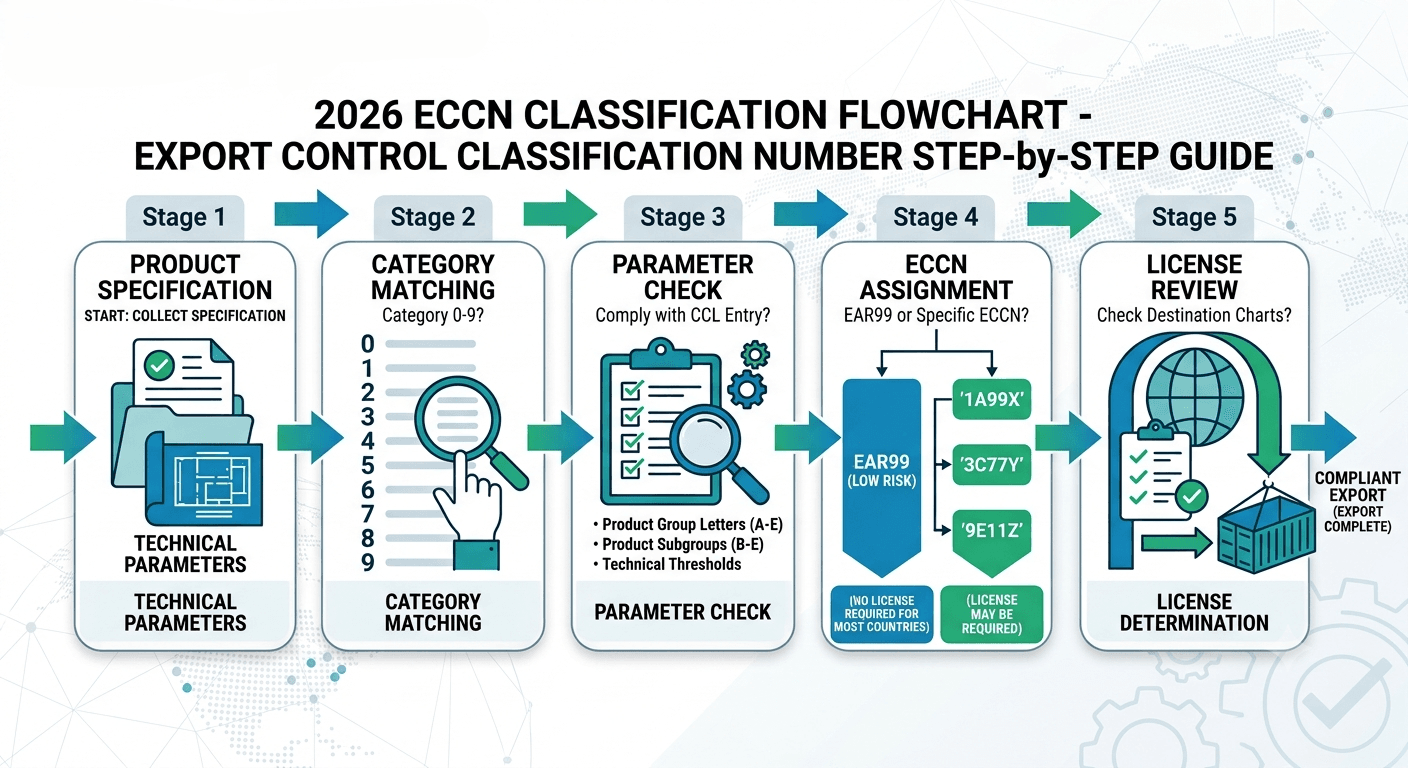
  1. Review product technical specifications thoroughly
  2. Search the official Commerce Control List (CCL)
  3. Match against category and product group descriptions
  4. Check performance parameters and "specially designed" notes
  5. Consult manufacturer data or BIS resources when uncertain

FreightAmigo experts can guide you through complex classifications.


2026 ECCN Classification Flowchart - Export Control Classification Number Step-by-Step Guide

ECCN vs EAR99: Key Differences

Most items fall under EAR99, but knowing when to use a specific ECCN prevents compliance failures.

  • ECCN: Specific code on CCL for controlled items
  • EAR99: Catch-all for items not listed on CCL
  • ECCN often triggers license requirements
  • EAR99 generally allows license-free export except in restricted cases

Always verify end-use, end-user, and destination even for EAR99 items.

ECCN vs HS Codes: Clear Comparison

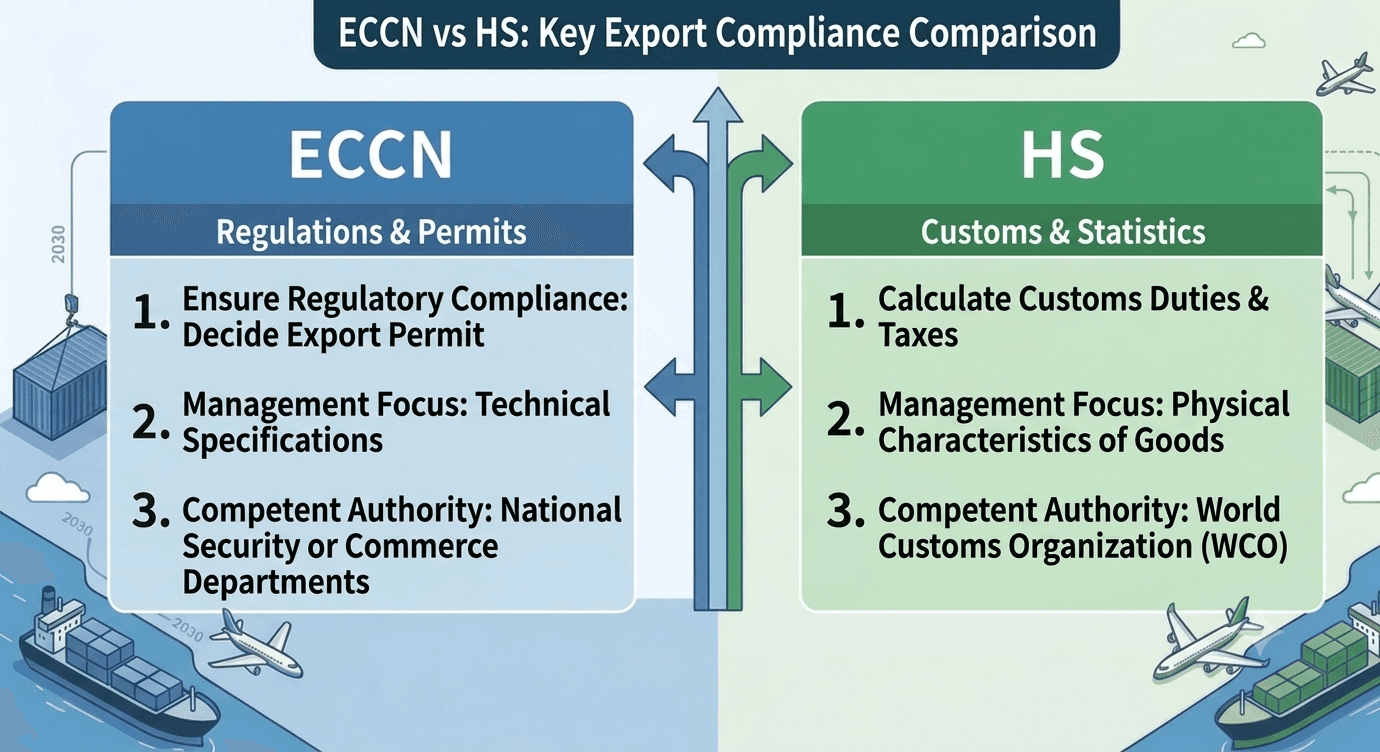
ECCN and HS/Schedule B codes serve different purposes in the shipping process.

AspectECCNHS / Schedule B Code
PurposeExport controls & licensingTariff & statistical classification
Format5 alphanumeric characters10+ digits
AgencyBIS (Commerce)Census Bureau / Customs
Applies toDual-use & controlled itemsAll physical goods
License ImpactDirectNone

Use both correctly for full compliance.


ECCN vs HS: Key Export Compliance Comparison

Common Compliance Pitfalls and How to Avoid Them

Avoid these frequent mistakes that lead to delays and penalties in 2026.

  • Relying solely on manufacturer-provided codes without verification
  • Ignoring updated semiconductor and AI controls
  • Failing to screen end-users against restricted lists
  • Using outdated CCL information

Regular audits and expert support minimize these risks.

Best Practices for ECCN Classification in 2026

Implement these strategies for robust, audit-ready compliance.

  • Train teams on current EAR requirements annually
  • Document every classification decision thoroughly
  • Leverage automated tools and BIS resources
  • Consult professionals for novel or high-tech items
  • Integrate classification into your shipping workflow early

FreightAmigo’s platform streamlines compliance alongside competitive freight rates.

Frequently Asked Questions (FAQ)

What does ECCN stand for in 2026?

ECCN stands for Export Control Classification Number. It is a five-character code used under U.S. EAR to identify items subject to export controls.

How do I find the ECCN for my product?

Review technical specs against the CCL, consult the manufacturer, or submit a BIS classification request. Self-classification is common but requires careful parameter matching.

Is ECCN the same as HS code?

No. ECCN controls export licensing while HS codes handle tariffs and statistics. Both are usually required for international shipments.

What is EAR99 and when does it apply?

EAR99 applies to items not specifically listed on the CCL. It generally allows export without a license unless destination, end-use, or end-user restrictions apply.

Do all shipments need an ECCN?

No. Only items on the CCL require a specific ECCN; most commercial goods default to EAR99. Always confirm.

How have 2026 updates affected ECCN for semiconductors?

BIS expanded controls on advanced computing chips and related equipment with new performance thresholds. Many items previously EAR99 now require specific ECCNs.

What happens if I ship with the wrong ECCN?

Misclassification can result in fines, shipment seizures, and loss of export privileges. Accurate classification is mandatory.

How can FreightAmigo help with ECCN compliance?

Our logistics experts provide guidance, resources, and integrated solutions to simplify classification and global shipping. Contact us for support.

Ready to ship compliantly and cost-effectively?

For expert guidance, Book a Demo with FreightAmigo. 

HKG Business +852 24671689 /+852 23194879, Personal +852 28121686 / +852 23194878 ︳CHN +86 4008751689 ︳USA +1 337 361 2833 ︳GBR +44 808 189 0136 ︳AUS +61 180002752 ︳Email: enquiry@freightamigo.com