CBM—cubic meter—is the internationally accepted unit for measuring the volume of space cargo occupies inside a shipping container.
In 2026, with freight rates continuing to fluctuate and supply chain efficiency under increasing pressure, understanding CBM is no longer optional for importers and exporters—it is essential.
CBM directly affects:
Freight cost calculation (carriers charge by CBM or weight, whichever is higher)
Container loading planning and LCL consolidation decisions
Customs declarations and compliance documentation
Carbon footprint reporting, increasingly required under 2026 ESG frameworks
Getting CBM wrong means overpaying for freight, wasting space, or facing costly cargo rejections at the port.
The Exact CBM of a Standard 40ft Container
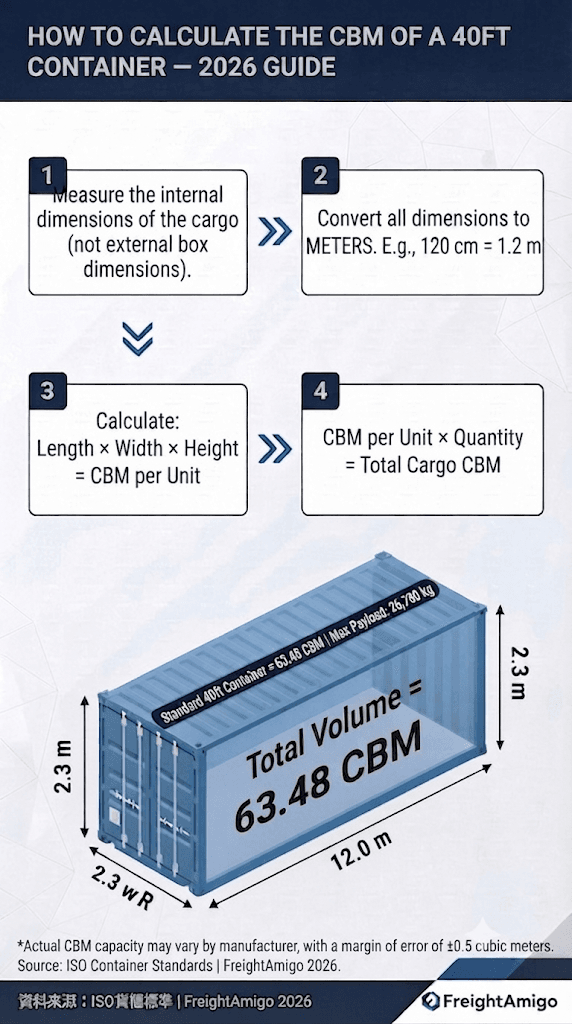
The loadable volume of a standard 40ft dry cargo container is approximately 63.48 cubic meters (CBM).
This is the industry-standard figure used by freight forwarders, carriers, and customs authorities worldwide.
This figure is calculated from the usable internal dimensions of the container, not the external measurements. Always use internal dimensions when planning your load.
Quick Formula: Internal Length (m) × Internal Width (m) × Internal Height (m) = CBM 12.0 m × 2.3 m × 2.3 m = 63.48 CBM
Actual figures may vary by ±0.5 CBM depending on the container manufacturer or the age of the unit.
40ft Container Internal Dimensions Breakdown
When you are loading cargo worth tens of thousands of dollars, every millimeter of internal space matters.
Here are the precise internal dimensions of a standard 40ft dry cargo container:
Dimension
Millimeters (mm)
Meters (m)
Internal Length
12,000 mm
12.00 m
Internal Width
2,300 mm
2.30 m
Internal Height
2,300 mm
2.30 m
Total CBM
—
63.48 m³
These are loadable internal dimension figures. External dimensions are larger and must not be used for cargo planning.
Always confirm actual container specifications with your freight forwarder or carrier before finalizing your loading plan.
Container Specifications: Weight, Payload, and Gross Mass Limits
Beyond volume, weight limits are equally critical—exceeding them results in port fines, cargo delays, and serious safety risks.
Standard 40ft dry cargo container specifications:
Tare Weight: approximately 3,701 kg (weight of the empty container itself)
Maximum Payload: approximately 26,780 kg (maximum cargo weight permitted)
Maximum Gross Mass: approximately 30,480 kg (tare weight + payload combined)
Door Opening Width: approximately 2,286 mm
Door Opening Height: approximately 2,261 mm
In 2026, many port authorities and carriers have strengthened enforcement of VGM (Verified Gross Mass) declarations under SOLAS regulations. Non-compliant containers will be refused loading.
Always weigh your loaded container before the port cut-off and submit an accurate VGM declaration.
40ft Standard vs. 40ft High Cube: CBM Comparison Table
Many shippers overlook the 40ft High Cube container—a simple upgrade that adds nearly 9 extra CBM of vertical space.
If your cargo is light but voluminous, a High Cube is almost always the better choice.
Specification
40ft Standard (GP)
40ft High Cube (HC)
Internal Length
12.00 m
12.00 m
Internal Width
2.30 m
2.30 m
Internal Height
2.30 m
2.69 m
Total CBM
63.48 m³
approx. 76.3 m³
Tare Weight
approx. 3,701 kg
approx. 3,900 kg
Maximum Payload
approx. 26,780 kg
approx. 26,580 kg
Best Cargo Type
Dense / heavy cargo
Voluminous / light cargo
Surcharge vs. GP
Base rate
Typically +5–15%
Availability (2026)
Very abundant
Abundant
Pro Tip: If your cargo density is below 10 kg per CBM, request a High Cube quote on the FreightAmigo platform to compare the full landed cost.
How to Calculate the CBM of Your Cargo
Calculating your total cargo CBM is a straightforward process every shipper must complete before booking a container.
Follow these steps:
Measure each carton or pallet—record length, width, and height in centimeters (cm)
Multiply by quantity—CBM per unit × number of pieces = total CBM
Compare against container capacity—confirm total CBM fits within the 63.48 m³ limit (standard 40ft) or adjust container type accordingly
Calculation example:
Carton dimensions: 100 cm × 80 cm × 60 cm = 1.0 m × 0.8 m × 0.6 m = 0.48 CBM per carton
Quantity: 100 cartons
Total CBM: 0.48 × 100 = 48 CBM → fits in a 40ft standard container with room available for consolidation
Many digital platforms, including the FreightAmigo freight calculator, automate this calculation in real time, reducing human error in load planning.
Strategies to Maximize CBM Utilization in a 40ft Container
Under-loading is one of the most common and costly mistakes in international shipping.
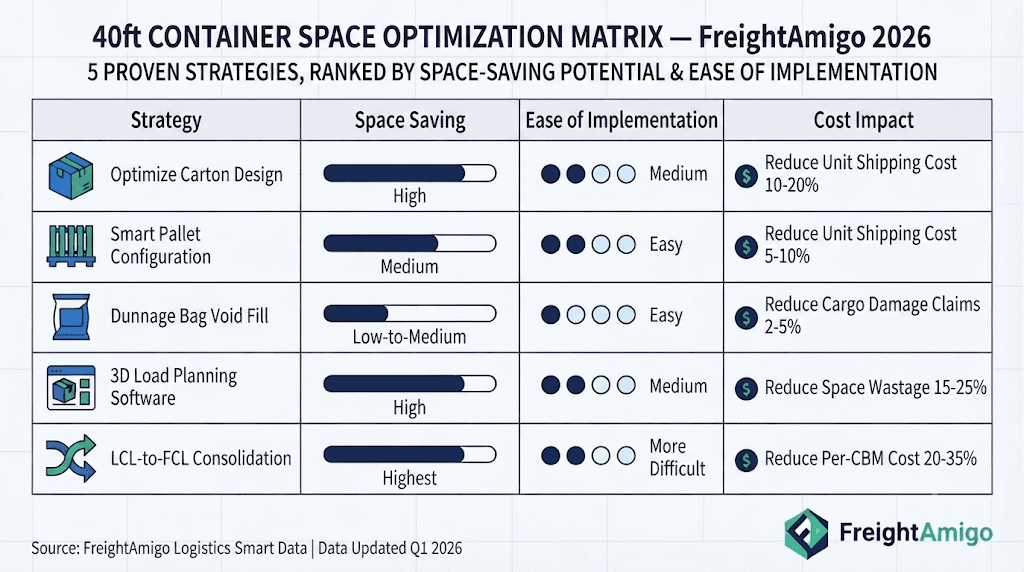
With the right strategies, idle space can be converted into measurable cost savings:
Optimize carton dimensions—work with manufacturers to design packaging that stacks cleanly and minimizes dead air space
Apply smart palletization—standard pallets (1200 × 1000 mm) fit efficiently in a 40ft container; consider double-stacking where cargo weight allows
Use dunnage bags appropriately—inflatable dunnage bags fill lateral gaps, prevent cargo shifting, and add minimal weight
Use container loading software—tools integrated into platforms like FreightAmigo generate 3D loading plans within minutes
Consolidate LCL shipments toward FCL thresholds—when cargo regularly exceeds approximately 15–18 CBM per shipment, booking a full 40ft FCL container is typically more cost-effective than LCL
A well-planned loading arrangement also reduces cargo damage claims and insurance costs—a compounding benefit that affects your bottom line with every shipment.
Challenges and Solutions in 40ft Container Shipping
Every experienced logistics manager knows that booking a 40ft container is only the first step—the real challenges begin at execution.
Here are the most common obstacles in 2026 and practical solutions:
Weight vs. volume conflict: Dense cargo may reach the 26,780 kg payload limit before filling 63.48 CBM. Solution: split cargo between a 40ft standard and a 20ft container, or renegotiate product specifications with the supplier.
Port restrictions: Some regional ports and inland depots impose size or axle load restrictions on 40ft containers. Confirm with your freight forwarder before booking.
Loading balance errors: Uneven weight distribution causes containers to tip during handling and road transport. Use 3D load planning tools with center-of-gravity calculation.
Customs packing declarations: Certain destination markets—particularly Australia, the United States, and the EU—require detailed packing lists and fumigation certificates. Digital platforms can auto-generate these documents.
Equipment availability tightness: In 2026, peak season demand—especially in Q4—creates 40ft container shortages on Asia–Europe and transpacific trade lanes. Book 4–6 weeks in advance during peak periods.
Working with a digital logistics platform that provides real-time carrier data significantly reduces your exposure to these risks.
How the FreightAmigo Digital Platform Optimizes Container Shipping
FreightAmigo is a full-service digital supply chain and financial platform built to help businesses take complete control of 40ft container shipments.
Features available on the platform in 2026:
Real-time multi-carrier quote comparison—compare FCL ocean freight rates across dozens of carriers instantly, with 40ft standard and High Cube options side by side
AI-assisted load planning—optimize your CBM utilization before booking to eliminate wasted space
24/7 shipment tracking—real-time container tracking across all major global trade lanes
Automated document generation—bills of lading, packing lists, and customs declarations generated automatically
Cargo insurance integration—insure your 40ft container shipment directly through the platform
Expert logistics support—certified freight specialists available to resolve complex routing questions
These features translate directly into lower cost per CBM, fewer delays, and full cargo visibility from origin to destination.
Frequently Asked Questions
What is the CBM of a standard 40ft container?
A standard 40ft dry cargo container has a loadable volume of approximately 63.48 cubic meters (CBM), calculated from internal dimensions of 12.0 m (length) × 2.3 m (width) × 2.3 m (height). Actual figures may vary slightly by manufacturer.
How many CBM does a 40ft High Cube container hold?
A 40ft High Cube (HC) container provides approximately 76.3 CBM of internal volume, thanks to its additional height of 2.69 m compared to the standard 2.30 m. It is ideal for cargo that is light and voluminous and not approaching payload limits.
How do I calculate the CBM of my cargo?
Multiply the length × width × height of each carton in meters, then multiply by the quantity. For example, a carton measuring 1.0 m × 0.8 m × 0.6 m = 0.48 CBM per carton. Multiply by quantity to get total cargo CBM.
What is the maximum payload of a 40ft container?
The maximum payload of a standard 40ft container is approximately 26,780 kg. The gross mass limit (tare weight plus cargo) is typically 30,480 kg. Always confirm with your carrier, as limits vary by shipping line and port regulation.
What is the difference between a 40ft GP and a 40ft HC container?
The key difference is height: a 40ft GP has an internal height of 2.3 m (63.48 CBM), while a 40ft HC has an internal height of 2.69 m (approximately 76.3 CBM). The High Cube offers approximately 12.8 additional cubic meters and is better suited for large but lighter cargo.
When should I use a 40ft container instead of a 20ft container?
Use a 40ft container when your cargo exceeds approximately 25–28 CBM or when you need to consolidate multiple product lines in a single load. A 40ft container typically offers a lower cost per CBM than booking two 20ft containers for the same volume.
How many pallets fit in a 40ft container?
A standard 40ft container can accommodate approximately 20–21 standard Euro pallets (1200 × 800 mm) or 23–24 standard US pallets (1200 × 1000 mm) in a single layer. Double-stacking may be possible depending on cargo height and weight.
What documents are required for a 40ft FCL shipment?
Typical required documents include: Bill of Lading (B/L), commercial invoice, packing list, certificate of origin, Verified Gross Mass (VGM) declaration, and destination-specific certificates (such as phytosanitary certificates, fumigation certificates, or Safety Data Sheets). FreightAmigo can auto-generate most of these documents digitally.
How far in advance should I book a 40ft container?
The industry best practice for 2026 is to book 4–6 weeks in advance for peak season shipments (September to December) on major trade lanes. Off-peak bookings can be made 2–3 weeks in advance, but earlier booking always secures better rates and equipment availability.
Conclusion: Your 2026 Smart Container Shipping Action Plan
Understanding the 63.48 CBM capacity of a standard 40ft container is the foundation for efficient, professional international shipping in 2026.
From smarter packaging to digital load planning, every optimization compounds into measurable cost savings and fewer operational headaches over time.
Your 2026 container shipping checklist:
Always calculate total CBM before selecting a container type
Compare 40ft standard and High Cube options based on cargo density, not habit
Submit an accurate VGM declaration before the port cut-off
Use digital load planning tools to eliminate wasted space
Book 4–6 weeks in advance during peak season to secure equipment
Use a digital freight platform to compare rates and auto-generate documentation
The FreightAmigo platform combines real-time rate comparison, automated document generation, and expert logistics support in a single interface—designed specifically to address these challenges.





















 Global Popular RoutesTop sea & air shipping lanes
 Special OfferLimited-time shipping promotions


 Express
 Document
 Parcel - Air/Sea
 Container
 Relocation