What is Commercial Merchandise for US Customs? A Comprehensive Guide for Importers and Exporters
Want To Compare The Best Express, Air Freight, Sea Freight, Rail Freight & Trucking Rates So As To Have Better Control On Cost?
Introduction: Understanding US Customs and Commercial Merchandise
In the world of international trade, understanding the intricacies of customs regulations is crucial for businesses and individuals alike. One of the most important aspects to grasp is the concept of commercial merchandise as defined by US Customs. This knowledge is essential for anyone involved in importing or exporting goods to and from the United States. In this comprehensive guide, we'll explore what constitutes commercial merchandise for US Customs, the role of the US Customs and Border Protection (CBP) agency, and how digital logistics platforms like FreightAmigo can help streamline the customs process.
Before we delve into the details, let's take a look at some key facts about US Customs and commercial merchandise:
The United States Customs and Border Protection (CBP) is the largest agency within the Department of Homeland Security.
CBP was formed in 2003
In 2022, CBP processed $3.36 trillion worth of imports and collected approximately $111.01 billion in duties, taxes, and other fees.
CBP employs over 60,000 personnel, including CBP Officers, Agricultural Specialists, and Import Specialists.
FreightAmigo lets you benchmark air, sea, rail, and trucking quotes side-by-side—no phone calls required.Get Instant Quotes
Defining Commercial Merchandise for US Customs
Commercial merchandise, as defined by US Customs and Border Protection (CBP), refers to any goods or products imported into the United States for commercial purposes—including items intended for sale, use in business operations, or further manufacturing.
This definition is broader than most traders expect. Even a small parcel shipped to a US business address may be classified as commercial if it shows any intent of resale or business application.
The CBP does not use a single dollar threshold to separate personal from commercial imports. Instead, officers evaluate a combination of factors including quantity, frequency, documentation, and declared purpose.
Key Characteristics of Commercial Merchandise
To help you better understand what constitutes commercial merchandise for US Customs, let's explore some key characteristics:
Intended for Sale or Business Use: Commercial merchandise is typically imported with the intention of being sold in the US market or used in business operations.
Quantity: Generally, commercial merchandise is imported in larger quantities than personal items. However, even small quantities can be considered commercial if they are intended for resale or business use.
Value: While there's no specific value threshold that automatically defines merchandise as commercial, higher-value shipments are more likely to be classified as such.
Frequency of Importation: Regular or frequent importations of similar goods are often indicative of commercial activity.
Nature of the Goods: Certain types of goods, such as raw materials, industrial equipment, or bulk consumer products, are more likely to be classified as commercial merchandise.
In 2026, CBP has increasingly deployed AI-assisted risk scoring to flag shipments for secondary review. Accurate, consistent documentation is your strongest defense.
The Role of US Customs and Border Protection (CBP) in Regulating Commercial Merchandise
The United States Customs and Border Protection (CBP) plays a crucial role in regulating the import and export of commercial merchandise. As the primary border control agency of the United States, CBP is responsible for enforcing customs laws, collecting duties, and ensuring the safety and legality of goods entering and leaving the country.
Key Responsibilities of CBP
When it comes to commercial merchandise, CBP has several important responsibilities:
Customs Clearance: CBP officers are responsible for processing and clearing commercial shipments entering the United States. This involves verifying documentation, assessing duties and taxes, and ensuring compliance with import regulations.
Enforcement of Trade Laws: CBP enforces various trade laws and regulations, including those related to intellectual property rights, anti-dumping measures, and countervailing duties.
Security Screening: CBP conducts security screenings of commercial shipments to prevent the entry of prohibited or dangerous items, such as illegal drugs, weapons, or counterfeit goods.
Collection of Duties and Taxes: CBP is responsible for calculating and collecting duties, taxes, and fees on imported commercial merchandise.
Trade Facilitation: While enforcing regulations, CBP also works to facilitate legitimate trade Trade Partnership Against Terrorism (C-TPAT).
In 2026, CBP's Automated Targeting System (ATS) uses machine-learning models trained on billions of historical cargo records, making accurate manifest data more critical than ever.
The Import Process for Commercial Merchandise
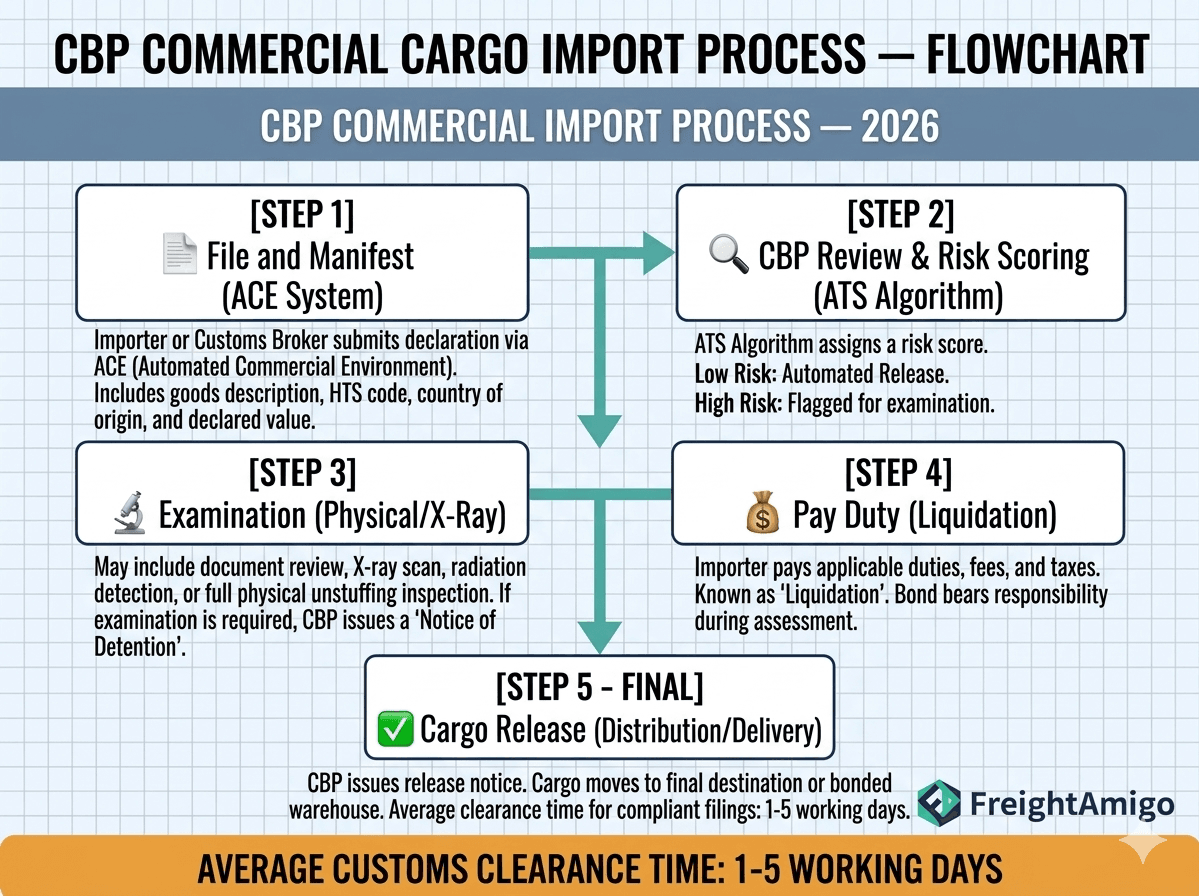
Importing commercial merchandise into the United States involves a series of steps and procedures overseen by CBP. Understanding this process is essential for businesses engaged in international trade. Let's break down the key stages of the import process:
1. Entry Filing
The import process begins with the filing of an entry. This can be done electronically through the Automated Commercial Environment (ACE) system. The entry includes information about the shipment, such as the nature of the goods, their value, and the country of origin.
2. Examination and Release
Once the entry is filed, CBP will review the documentation and may conduct a physical examination of the goods. This process includes:
Document Review: Checking commercial invoices, packing lists, and certificates of origin for accuracy.
X-Ray / Gamma-Ray Scanning: Non-intrusive inspection of container contents without physical unloading.
Radiation Portal Monitoring: Every arriving container passes through radiation detection equipment.
Tailgate / Intensive Exam: Full physical unloading and item-by-item inspection for flagged shipments.
3. Payment of Duties and Fees
After the examination, the importer is required to pay any applicable duties, taxes, and fees. This process, known as liquidation, finalizes the customs entry.
4. Release of Goods
Once all requirements are met and payments are made, CBP will release the goods for distribution or further processing within the United States.
Worried about customs holds? FreightAmigo's customs clearance service connects you with licensed brokers who manage your CBP filings end-to-end.Request Customs Support
Personal Use vs. Commercial Merchandise: Key Differences
One of the most common compliance errors in 2026 is incorrectly declaring commercial goods as personal-use items to avoid duties—a practice CBP actively detects and penalizes.
Understanding the distinction between personal-use imports and commercial merchandise protects you from fines up to 4× the unpaid duty value under 19 U.S.C. § 1592.
Factor
Personal Use
Commercial Merchandise
Primary Intent
Personal consumption / gifting
Resale, manufacturing, business use
Typical Quantity
Single units / small quantities
Bulk / wholesale quantities
De Minimis Exemption
Eligible (under $800)
Not eligible
Duty Assessment
Sometimes exempt
Always assessed
Formal Entry Required
Usually not required
Required above $2,500
Customs Bond Required
No
Yes (for formal entries)
Importer of Record
Not required
Mandatory
CBP Risk Score
Low
Variable (based on HTS, origin, value)
Navigating Customs Regulations: Tips for Importers and Exporters
Dealing with customs regulations can be complex, but there are several strategies that importers and exporters can employ to ensure smooth transactions:
1. Stay Informed About Regulations
Keep up-to-date with the latest customs regulations and trade policies. CBP regularly updates its guidelines, and staying informed can help you avoid compliance issues.
2. Properly Classify Your Goods
Accurate classification of your merchandise is crucial. Use the Harmonized Tariff Schedule (HTS) to determine the correct classification codes for your products.
3. Maintain Accurate Documentation
Ensure all your customs documentation is complete, accurate, and up-to-date. This includes commercial invoices, packing lists, and certificates of origin.
4. Consider Customs Bonds
For regular importers, obtaining a customs bond can help streamline the import process and provide financial security for CBP.
5. Leverage Technology and Digital Platforms
Utilize digital logistics platforms like FreightAmigo to streamline your shipping processes and ensure compliance with customs regulations.
Essential Documentation Checklist for US Customs
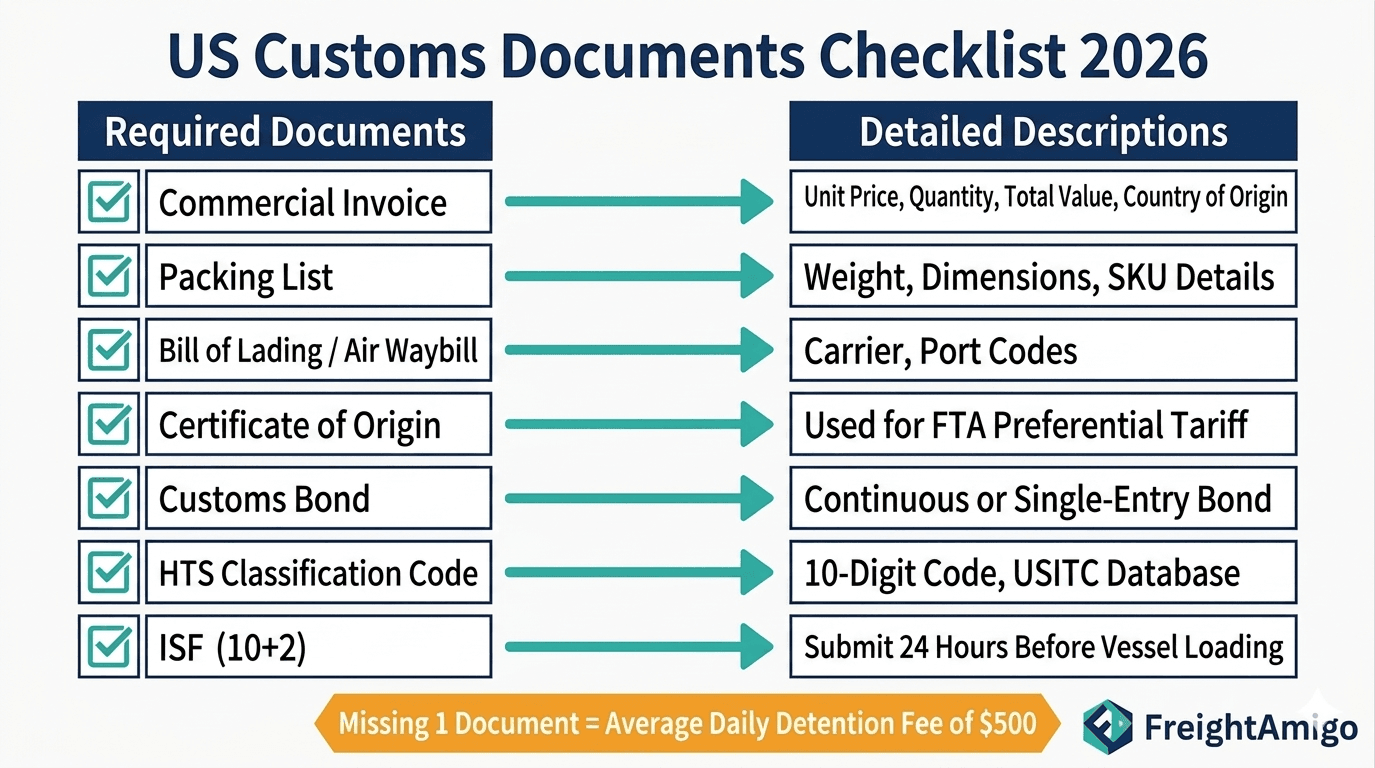
Every commercial merchandise shipment entering the United States must be accompanied by a specific set of documents, and even one missing or inaccurate field can trigger a customs hold that costs hundreds of dollars per day in demurrage fees.
Packing List: Carton count, gross/net weight, dimensions, and SKU detail per line item.
Bill of Lading / Air Waybill: Issued by the carrier; confirms shipment terms and container/flight details.
Certificate of Origin: Required to claim preferential duty rates under FTAs like USMCA or KORUS.
ISF 10+2 Filing: Ocean imports only—must be submitted at least 24 hours before loading at the foreign port. Penalty: up to $5,000 per violation.
Customs Entry (CBP Form 3461 or 7501): The official entry document initiating the formal clearance process.
How FreightAmigo Can Help with Customs Compliance and International Shipping
As a digital logistics platform, FreightAmigo offers several features that can significantly simplify the process of importing and exporting commercial merchandise:
1. Comprehensive Quote Comparison
FreightAmigo allows you to compare door-to-door freight quotes for various shipping methods, including international courier, airfreight, sea freight, rail freight, and trucking solutions. This enables you to choose the most cost-effective and efficient option for your commercial shipments.
2. Real-Time Shipment Tracking
With FreightAmigo's tracking feature, you can monitor your shipment status anytime, anywhere. This real-time visibility helps you stay informed about your cargo's progress through customs and other checkpoints.
3. Customs Clearance Assistance
FreightAmigo offers customs clearance services, helping you navigate the complex world of customs regulations and ensuring your commercial merchandise complies with all necessary requirements.
4. Automated Documentation
FreightAmigo's platform automates the generation of shipment documents, reducing the risk of errors and ensuring all necessary paperwork is in order for customs clearance.
5. Expert Support
With 24/7 access to logistics experts, FreightAmigo provides the support you need to address any customs-related questions or issues that may arise during the shipping process.
Frequently Asked Questions
Q1: What is commercial merchandise according to US Customs? Commercial merchandise refers to goods imported or exported for sale, business use, or resale. These items require formal entry, proper documentation, and payment of duties, unlike personal effects or gifts.
Q2: What is the difference between commercial merchandise and personal shipments? Commercial merchandise is intended for business or resale and must follow full customs formalities. Personal shipments (e.g., gifts or personal belongings) usually have lower value limits and simpler procedures.
Q3: Why is a commercial invoice required for US imports? A commercial invoice is mandatory for all commercial shipments. It provides detailed information about the goods, value, origin, and buyer/seller, which US Customs uses to determine duties, taxes, and compliance.
Q4: What are the key elements that must be included in a commercial invoice? A proper commercial invoice must include seller and buyer details, detailed description of goods, quantity, unit price, total value, country of origin, HTS code, and Incoterms.
Q5: How does US Customs determine the value of commercial merchandise? US Customs primarily uses the transaction value method (price actually paid or payable). If that cannot be used, they apply alternative valuation methods such as deductive value or computed value.
Q6: What happens if I misclassify or undervalue commercial merchandise? Misclassification or undervaluation can lead to delays, penalties, fines, seizure of goods, or even legal action. Accurate HTS code classification and valuation are critical.
Q7: Do all commercial shipments need to be declared to US Customs? Yes. Shipments valued over USD 800 generally require formal entry. Even lower-value shipments may need informal entry or Section 321 clearance, depending on frequency and type.
Q8: How can FreightAmigo help with US commercial merchandise shipments? FreightAmigo provides expert guidance on commercial invoices, HTS classification, customs clearance, duty calculation, and compliance support, helping importers and exporters avoid costly mistakes and ensure smooth US customs clearance.
Understanding what constitutes commercial merchandise for US Customs and navigating the associated regulations is crucial for successful international trade.
As the global trade landscape continues to evolve, embracing digital solutions becomes increasingly important. FreightAmigo's comprehensive Digital Logistics Platform offers the tools and support needed to navigate the complexities of international shipping and customs procedures efficiently.
Whether you're a seasoned importer or just starting your international trade journey, remember that staying informed and utilizing the right resources can make a significant difference in your success.
For expert guidance, Book a Demo with FreightAmigo.








 Global Popular RoutesTop sea & air shipping lanes
 Special OfferLimited-time shipping promotions





 Express
 Document
 Parcel - Air/Sea
 Container
 Relocation